





One of the most persistent mistakes I see early-stage founders make is treating the customer as a single entity. They'll say things like "our customer is a hospital" or "a Series A SaaS startup." But organizations don't buy products. People do. And the people inside those organizations often want very different things, because they each have fundamentally different problems to solve for.
If you only talk to one type of person inside your target organization, you are getting a partial picture at best, and a dangerously misleading one at worst.
The laptop example
Every few years, NYU issues me a new laptop. My problem is real and specific: I spend most of my day moving between meetings and offices, and if my machine is too heavy I either leave it behind and can't work, or I carry it and pay for it physically. Speed, weight, and compatibility are not preferences. They are the solution to that problem.
Now ask our IT administrator. Their problem is completely different. When a device gets lost or compromised, they are responsible for a potential data breach with no way to contain it remotely. Manageability and security are not requirements. They are how they avoid that outcome.
And our budget officer? Their problem is getting surprised by unbudgeted replacement and support costs mid-cycle, which blows their annual plan. Total cost of ownership is not a preference. It is how they stay in control of a budget they are accountable for.
Organizations don't buy products. People do.
Same laptop. Three completely different problems to solve for. Three different people you need to understand if you want to sell into that organization.
The six roles you need to know
At the Leslie Entrepreneurial Institute, we teach founders to think about the customer ecosystem as a set of distinct roles, each with their own problems to solve for, and each requiring a different conversation.
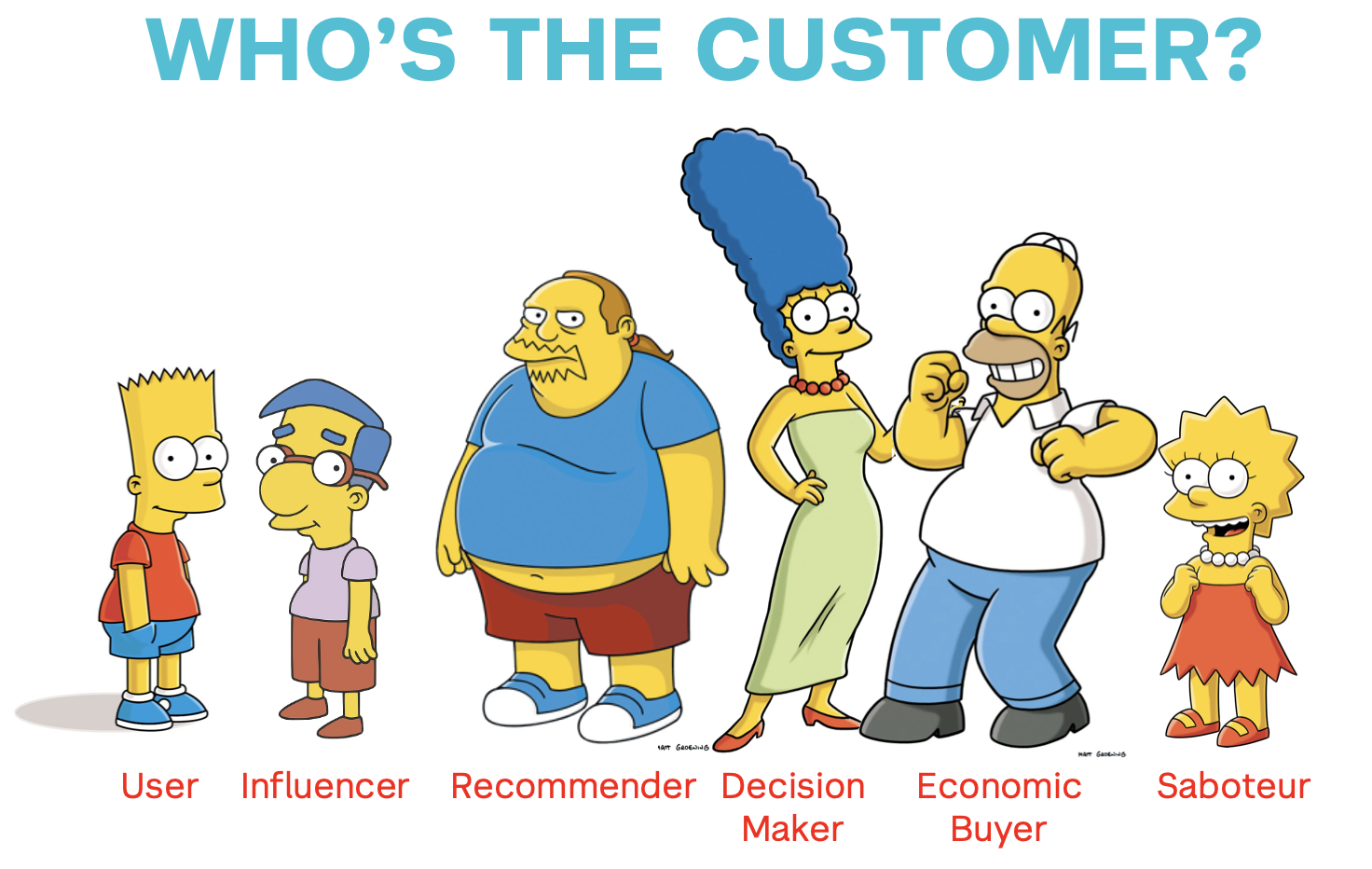
- The User is the person who actually uses your product day to day. They have the most direct and immediate experience with the workflow, the friction, and the failure modes your product addresses. But they often have limited power to make purchasing decisions.
- The Influencer shapes the decision without making it. They might be a respected colleague, a department head, or an outside advisor whose opinion carries weight. They are not in the room when the final call is made, but they were in the room before it.
- The Recommender has formal authority to put your product in front of decision makers. In healthcare, this might be a department head. In enterprise software, it might be a procurement lead. They are the ones who say "you should consider this."
- The Decision Maker has the authority to say yes, but often has the least direct experience with the problem the user is trying to solve. Their problem is different: evaluating risk, managing organizational priorities, and making a judgment call based on what others tell them.
- The Economic Buyer controls the budget. Their problem is financial accountability. In large organizations, the CFO or budget officer who approves the purchase may have no idea what the product actually does, but they care deeply about what it costs and what value it returns.
- The Saboteur is the one nobody talks about enough. This is the person whose problem is that your solution threatens their interests. Maybe your product makes their job redundant. Maybe it shifts power from their department to another. Whatever the reason, they will work against you, quietly and often invisibly, if you do not account for them.
These roles are rarely in the same organization
Notice that nothing in those six definitions requires the people to work for the same organization. In many markets, they don't.
Healthcare is the clearest example. Take OraLiva, an NYU spinout that has developed a saliva-based oral cancer detection test. The user is the dentist performing the test, whose problem is identifying at-risk patients accurately and efficiently within a clinical workflow. The decision maker at a dental practice or health system is likely a clinical director, whose problem is evaluating new tools against clinical standards and operational impact. The economic buyer could be a claims examiner at a private insurer, whose problem is cost management and reimbursement structure. The recommender is a regulatory affairs reviewer at the FDA, whose problem is patient safety and regulatory compliance, and whose clearance is essentially a prerequisite for any clinical adoption. And the saboteur might be a salesperson at an incumbent diagnostic company whose commission depends on preserving their long-standing relationships with the same dental networks OraLiva is trying to reach.
Dentist. Clinical director. Claims examiner. Regulatory affairs reviewer. Salesperson. Different organizations, different problems, different incentives, different rules. And the patient, who has the most at stake in early cancer detection, has almost no role in the purchasing decision at all.
This is not unique to healthcare. Industries of all kinds, especially regulated ones including higher education, financial services, and others, have customer ecosystems that span multiple organizations by design. These roles are rarely housed in the same organization. And none of them are trying to solve the same problem.
How these roles interact matters as much as who plays them
A sale in a complex ecosystem is not a single conversation. It is a sequence of conversations, each of which has to go well for the next one to happen.
What this means practically is that you need a champion inside the organization, someone who will carry your case through the chain when you are not in the room. That champion could be anyone in the ecosystem, but they are usually the person with the most to gain from your solution and enough credibility to bring others along. Your job is to give them the right information, framing, and evidence for every conversation they will have on your behalf.
The practical implication
When you are doing customer discovery, you need to talk to people in multiple roles, not just the user. And you need to understand the specific problem each of them is trying to solve.
But here is the most important interview technique for uncovering the ecosystem in the first place: ask your interview subject to walk you through the last time they considered or adopted something roughly similar. Not what they would do hypothetically. What actually happened. Who got involved? Who had to sign off? Who pushed back and why? Who was consulted that you might not expect? That conversation will reveal the real ecosystem, the actual people, organizations, and problems in play, far more reliably than any org chart or assumption you bring into the room.
The founders who get this right do not just build better products. They build better go-to-market strategies, better pricing models, and better sales processes. Because they understand that a sale is not a single conversation. It is a series of conversations, with different people, about different problems, often happening simultaneously across organizations you do not fully control.
Start by knowing who those people are, and what problem each of them needs you to solve.
If you want to work through your customer ecosystem with a coach, book a session with our team at the Leslie Entrepreneurial Institute.


