





Glaucoma is the leading cause of blindness worldwide. It affects roughly 80 million people—including 2.7 million in the United States alone. Worse, this number is likely to skyrocket. Current glaucoma screening standards require bulky, expensive equipment, are difficult for disabled patients to navigate, and are tedious to the point of compromising results. Envision, a startup founded by Dr. Lama Al-Aswad, former professor of ophthalmology at NYU Langone, is poised to reinvent glaucoma testing by incorporating virtual reality and gamification.
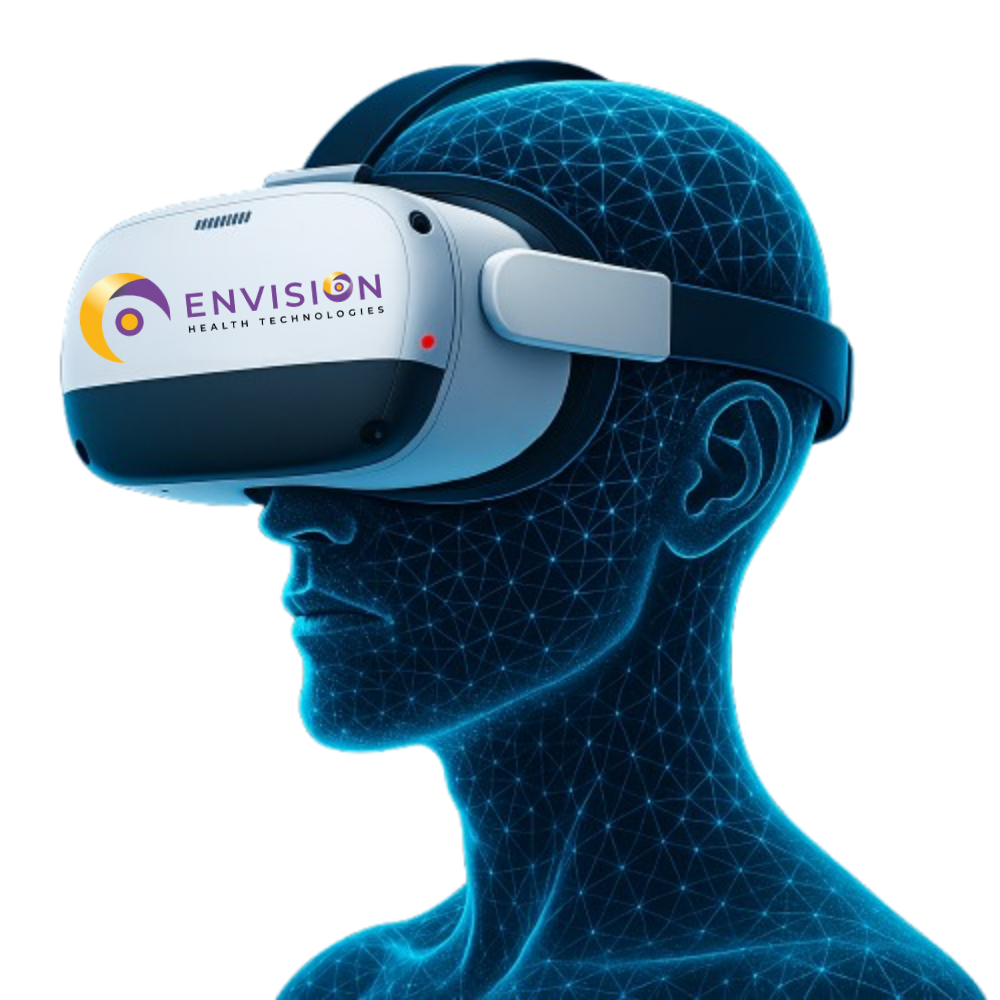
"Envision is software as a medical device, using a VR headset to test visual functions, starting with visual fields,” Al-Aswad explains.

"The current standard of care involves the use of a dark room, requires the presence of a technician and up to 30 percent of the tests are unusable because of how unengaging the patients find them. There’s a huge footprint. With Envision, the tests can be done anywhere with the headset and a tech can set it up and walk away. It’s much less expensive and greatly streamlines the workflow.”
The major value-add is the gamification of the testing process to keep patients engaged, thus producing better data. “The experience is similar to a game of Asteroids,” Al-Aswad says. “Patients play the game and when they respond or don’t respond, the game gives them audio and video feedback, a feature that’s absent in the current standard of care where they don’t know how they’re doing and it ramps up their anxiety. We did a lot of verification to ensure that gamification is compatible with the psychophysics of testing. At the first clinical trial, patients asked if they could use our tech instead of the standard of care in their future testing.”
Envision was born at an airport boarding gate. “After a day of frustrating visual field testing, I was flying to California and my flight was delayed,” Al-Aswad recalls. “I’m sitting there thinking, oh God, my last few patients didn’t benefit from their tests at all and suddenly I looked around and saw every passenger–even the elderly ones–playing games on their phones. And I thought to myself, I can't get patients to do a five-minute visual field test but they can do this non-stop.”
Al-Aswad initially attempted to engage a private company to build out the tech but when this proved financially unfeasible, she realized she was already well placed to get started. “I thought, well, why can’t I do this in my lab, the Ophthalmology Innovations Lab at NYU Langone,” she says. “So I created the Ophthalmology Innovation Fellowship and we started the process.” Naturally, a big part of doing so was understanding the business side of the equation. “As a clinician, I knew nothing about entrepreneurship and knew I had to start learning. That’s how I got connected with the Leslie Entrepreneurial Institute.”
The first step in the Envision team’s entrepreneurial evolution was participation in the fall 2021 cohort of the Tech Venture Workshop. “TVW was a crash course in entrepreneurship which was amazing since, as a clinician, I was used to being a student,” Al-Aswad says.
“This is where we learned how to take an idea to market.” Right off the bat, a major revelation was reached. “Who is our target customer? I had wanted to do this to give it to the patients,” she explains. “Through our learning at TVW, we realized that we couldn’t start with those individuals. The price of the technology and other factors made that too complicated so we redefined our initial target customer as clinical practices. We learned so much from the TVW team - they had a lot of resources and connected us to VCs and to people who had actually done this in the past.”
Having established that early target, the team set about identifying those clinical practices in the NSF’s I-Corps program in 2022. “The I-Corps experience was eye-opening because it was all about customer discovery, how to do it and isolating what information you need to come away with in the end,” Al-Aswad says. Explorations conducted at I-Corps also helped crystallize what Envision was, what it wasn’t and what it wanted to be. “I-Corps helped us understand the landscape and learn from other companies,” she recalls. “We differentiated ourselves better when we realized others were doing VR testing but that none were doing games. We also realized that we could learn from companies in other sectors. After studying companies like IBM that were great at hardware but not software, we ended up modeling ourselves after Microsoft, a software company that is device agnostic just as we wanted to be.”
With broad strokes of strategy mapped out and the foundations laid, the Envision team used a hard-earned spot in the inaugural cohort of the Tech Venture Accelerator to get a jump on execution. “If TVW and I-Corps taught us about entrepreneurship, TVA showed us how to take those lessons and actually build a company,” Al-Aswad explains. “We worked on details like structure, finances, finding accountants and lawyers, building out milestones and KPI’s - it was all about process.” Time in the Accelerator provided insights not just on what needed doing but also the best ways of going about doing them. “An example of the specialized knowledge we got was the approach to patents,” she says. “I used to think that you put out a patent and were good. They taught us that you need a patent strategy in which you keep increasing the number of patents and building on the previous ones. I would never have learned this without the TVA team. TVW and I-Corps were excellent first steps and TVA brought us home.”
Completing the NYU entrepreneurial pipeline has helped Envision rapidly attain new heights. The company recently reached an agreement with ZEISS Medical Technologies, world leader in visual field testing, to incorporate Envision’s technology into ZEISS’s portfolio in a variety of care settings. The rollout is planned for fall of 2026. Meanwhile, the team is hard at work developing the next generation of visual field testing, incorporating AI and advanced analytics. They are also looking to expand testing to other common eye conditions like macular degeneration. The ultimate goal, however, is no less than revolutionizing preventive screening. “Studies have shown that the more you test, the earlier you detect change or progression,” Al-Aswad explains. “And the earlier you detect, the more effectively you can intervene to prevent blindness. Right now, people can get tested maybe once a year and there are not enough eye-care providers worldwide. So while our ideal customer today is clinical practices, the true goal is remote monitoring for patients so we can detect and treat earlier than ever. Once the clinicians believe in it, the patients will follow.”


