





The American Heart Association reports that over 400,000 Americans die each year of cardiac arrest. Of these cases, more than 350,000 occur outside of a hospital. Cardiopulmonary resuscitation (CPR) can double or triple a person’s chances of survival if administered immediately but how many people are adequately trained to perform the procedure? Studies show that even trained hospital staff routinely fall short of guidelines, with compressions too slow, too shallow, and too often interrupted. So how many bystanders are truly ready to act? Relay Response, a NYU startup founded by Dr. Beno Oppenheimer, pulmonologist at NYU Langone and assistant professor at NYU Grossman, is stepping in to improve the odds.
“Relay Response is a mobile platform intended to coach and help professionals and laypeople to be proficient at performing CPR,” Oppenheimer says. “All the way from hands-only CPR to sophisticated practices such as advanced product life support. We use mobile tech to prompt users to be proficient in CPR protocols and best practices that save lives and increase survival rates.” There are two main products, one intended for the community at large and the other for in-hospital use. “The community application uses the accelerometer on a phone or a watch to pick up data on how well or not CPR is being performed and provides real time coaching through prompts on the screen,” he explains. “The in-hospital product is called ‘Sim in a Box’ and it’s a simulation lab that uses different modalities from various devices to help all the role players in a cardiac arrest scenario. We have our leader app to support the leader, a scribe app to support the scribe, compressor apps and airway apps and a coach app all connected through web sockets. Data gets pooled and used in real time to discuss changes, debrief, analyze team performance and design improvements.”
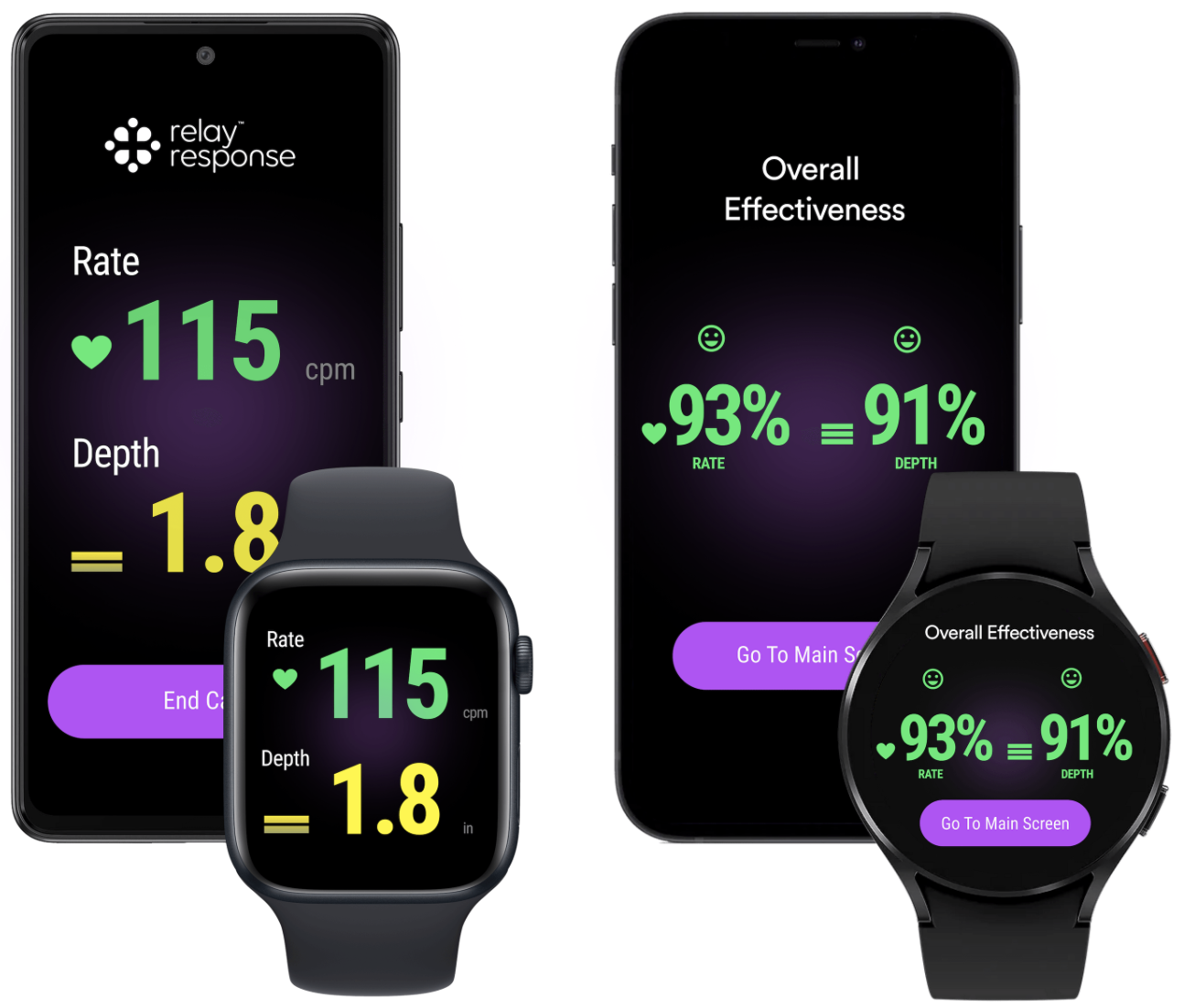
Relay Response was a personal project and labor of love for Oppenheimer. “The idea came from going to a teaching session in a live cardiac arrest scenario,” he recalls. “I came home and thought ‘God, that was horrible’ and started thinking about how we could put tech in everybody’s hands to facilitate things.” He invested personal time and funds in the work and conceived of the project as a commercial business from its inception. “I've always had business curiosity but never the guts to go for it,” he explains. “But when I decided to bootstrap this thing, I found my way downtown to the Leslie Entrepreneurial Institute and they said ‘let us help you build a company around this.’”
The need for such a product was clear to those involved but the crucial next step was figuring out how to articulate that to those who weren’t. “Frank Rimalovski told me that you don't want to have the coolest product that nobody can use, wants to use, will use, or much less pay for,” Oppenheimer recounts. “And I'm like, what are you talking about? We all have cardiac arrests. We all are going to want to use this. And now I'm seeing how right he was. The process of taking that research idea and finding an actual saleable pathway to a product was forged in the bowels of the Leslie eLab.”
The forge was first fired up with Oppenheimer’s participation in the NYU Tech Venture Workshop (TVW). “These initial efforts were instrumental in understanding what to do with the product and grow its usability,” he explains. “We defined and learned how to present the value proposition and product solution fit and answer the crucial questions. Your idea is great but does it resolve what you want to resolve? Is it medical-grade? How will the quality management system work? Those were the first steps in the story.”
Oppenheimer continued the product’s evolutionary arc with participation in the NIH’s I-Corps program. “First thing I had to do here was get rid of my biases, starting with believing I’m a physician and so I know what I’m talking about,” he chuckles. “I’m certainly a physician but I don’t know what I’m talking about. We’re not very efficient.” It took getting out of the doctor’s office to bridge that gap. “I-Corps gave me the ability to take everything I learned, get out of the building, and put metrics to those lessons,” he explains. “That's where you start differentiating your users from your customers and testing through interviews your hypothesis of what those customers actually want. So the idea began morphing from something born of real life chaos in a clinical setting to the big educational need because, at the end of the day, medical ed-tech is a mega market and it forced me to look at the simulation and training angles.”
It was participation in the 2024-2025 cohort of the NYU Tech Venture Accelerator (TVA) that brought Oppenheimer’s forging process to a red hot peak. “TVA was the company’s big ‘aha’ moment from the commercial point of view,” he says. “You stop tinkering around with stupidity, you understand where stuff is, let’s go commercialize, how do you do this? And, at TVA, it’s by putting me in front of money.” Navigating those interactions was a challenge but TVA and the Institute team provided the tools. “I got these incredibly sophisticated coaches with ties to industry, which is essential” Oppenheimer recounts. “I was completely outside my comfort zone but the level of coaching I got was just outstanding. TVA is your window.”
Oppenheimer’s discussions with TVA coaches and mentors transcended mere presentation polishing to facilitating tectonic shifts in the business plan. “My discussions with the TVA team led to a major pivot,” he explains. “They emboldened me to pursue the community element of the product and that has been even more successful than the in-hospital stuff. The idea of certifying people in communities with our technology was born at TVA.” The valuable relationships cultivated there still support the company. “You know how they say you can lead a horse to water but can’t force it to drink,” he says. “Sometimes the horse needs handholding and a map to the water. The Institute team provides that and they instill trust as a result. You understand they will always be around for you. They’re an external advisory board with core knowledge to share with everybody and trust, guidance and empowerment to give without which it all feels like a shot in the dark. It’s not just raw knowledge - they create an environment in which you can make mistakes, bounce ideas off them until you’re ready to go get the prize.”
Working off that foundation, Relay Response is on a roll. “We signed our first commercial contract last October with Columbia University so we’re now making money,” Oppenheimer exclaims. “We have an agreement with the VA central office to train over 170 institutions with our tech. We’ve begun a pilot at the University of Massachusetts. That big ‘aha’ moment at TVA over the community aspect of the product is what we’re focusing on.” Plans for the future are also coalescing. “We’re looking to expand into new environments where training and certifications are needed,” he explains. “One big push is to make this accessible outside the United States. Given the standardized science and the quality we bring to the table, Relay Response is translatable to a global market.” The ultimate goal is clear - “We’re aiming to turn people at home into first responders.”


