





Someone in the US suffers a stroke every 40 seconds, according to the Centers for Disease Control. They are the fifth leading cause of death in the country and, of those who survive a first stroke, roughly 1 in 4 will experience a second stroke. This makes outpatient stroke monitoring and detection an essential service for survivors, one that’s often inadequately met. That’s where CaroRhythm, a startup co-founded by Nisha Maheshwari, PhD (Tandon ‘25) and Lokesh Sharma (Tandon ‘24), steps in. The Company intends to raise that bar with a wearable device that alerts patients and their doctors to stroke risk before symptoms actually manifest.
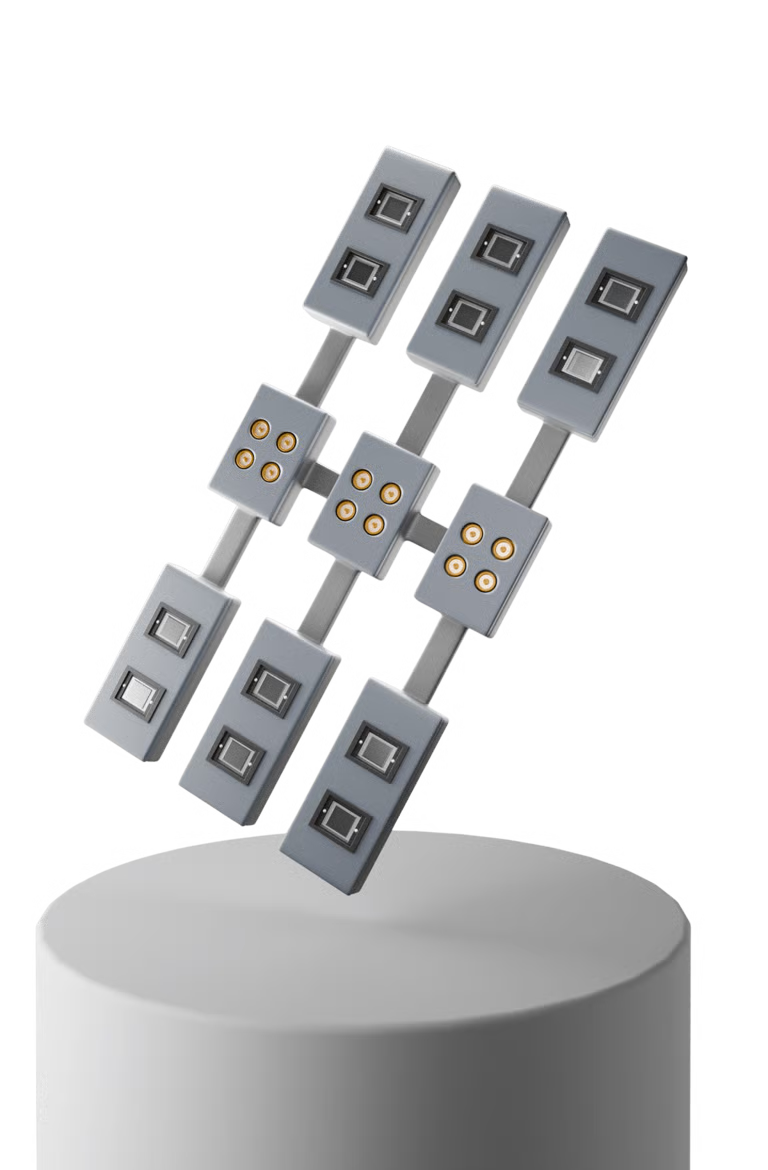
Strokes occur when blood flow to part of the brain is interrupted. CaroRhythm’s team designed a non-invasive patch that sits over the carotid artery and monitors that blood flow. “It uses light to irradiate tissue in the skin,” explains Maheshwari. “There are known biological properties, both of the tissue and its interaction with light, that we're able to use to reconstruct what's happening underneath the skin.” A reconstruction algorithm on the back end uses the sensor’s data to calculate information like oxygen saturation, presence of plaque and location of the arteries. Critically, this continuous monitoring provides patients with crucial insights into their vascular health and early alerts to facilitate timely intervention.
CaroRhythm emerged from Maheshwari and Sharma’s research at NYU Tandon’s Clinical Biophotonics Lab. “We were originally looking at a different vascular disease called peripheral arterial disease,” recalls Maheshwari. “In 2022, Dr. Albert Favate, an NYU Grossman vascular neurologist and the division chair of neurology at NYU Grossman, approached us with the challenges of monitoring effectively for strokes and the difficulty in controlling stroke symptoms, and we started to work on ways that our existing technology could be adapted to address this issue.” Both co-founders had first-hand experience with strokes in their families and were motivated to pivot their focus. With the help of Maheshwari’s PhD advisor Prof. Andreas Hielscher, the duo were able to develop a working prototype. His mentorship, informed by a background in commercializing research, also convinced them to go the entrepreneurial route. Sharma, then a master’s student, was encouraged by his NYU Tandon Future Labs sponsors to apply for their Technology Acceleration and Commercialization grant. Winning it gave them the confidence to dive right into the NYU entrepreneurship pipeline.
In the summer of 2023, they participated in the Entrepreneurial Institute’s Tech Venture Workshop, an experience that dramatically refined their strategy. “The Workshop was us throwing a very wide net and talking to physicians, inpatients, outpatients and doing a lot of customer discovery,” Sharma recalls. “That’s when we realized we’d been knocking on the wrong doors.” “The original problem Dr. Favate came to us with involved stimulation of the carotid artery but through customer discovery, we figured out that wasn’t the ‘hair on fire’ problem,” explains Maheshwari. “It was the monitoring side that people cared about. The low-hanging fruit, like the Entrepreneurial Institute team likes to say, is when the patient leaves the hospital. There's a significant gap where no one is being monitored, and they are at highest risk of recurrence right after their first stroke. We give patients agency to monitor themselves and get help before something bad happens. At TVW, we spoke to vascular neurologists and clinicians at Langone then branched out to stroke survivors and soon knew what direction we wanted to go.”
Their pioneering tech paired with this hard-won strategic clarity helped propel CaroRhythm to the grand prize at the 2023-2024 NYU Entrepreneurs Challenge. Not ones to rest on their laurels, they followed up by participating in the NSF’s I-Corps program and the Institute’s Tech Venture Accelerator (TVA). “At this point, we were sure there was a pipeline we could build,” says Sharma. “We just didn’t fully know how to build it. At TVA, we realized we were doing too much and not all of what we were doing was necessary.” An example of TVA-assisted streamlining was their go-to-market strategy. “Initially, we were flip-flopping about going through providers or payers,” Maheswari explains. “Then, at TVA, we spoke to a lot of insurance companies who said they don't care about new technologies until providers start using them. As a result, our market strategy is now focused on providers, on speaking with clinical administrators and economic buyers at healthcare institutions.”
Another benefit was access to expertise and the space to attain new skillsets. “We ended up connecting with many advisors we still reach out to for help,” says Sharma. “It’s so helpful since what you get at TVA is one-on-one mentorship and discussions that surface the right questions to ask and get answered.” Maheshwari adds, “One thing we've both noticed, especially for technical focused founders like us, is that a lot of this stuff you don't think about at all and your first exposure really is during these workshops and working with the Institute. You're just so focused on your product and technology that thinking about how it's going to get to the people who are using it just isn't something that crosses the mind. And now we’re learning how to speak with investors, form a good pitch deck, figure out the financial side. It was exciting to be able to learn all those things.”
None of that momentum is being wasted. The duo are in the process of conducting extensive interviews with stroke survivors and clinical administrators. Meanwhile, they are also working on an advanced prototype and engaging with the FDA to hit their planned three-year timeline to commercialization. A potential broadening of the initial scope is also on the horizon. “Right now we’re focused on stroke survivors and secondary prevention,” says Maheshwari. “Next we'll look into primary prevention, helping at-risk individuals in general—people who have diabetes, hypertension or are otherwise at high risk for having a stroke.” Their efforts to come out ahead on a crowded stage are rooted in a combination of humanist concern and curiosity. “We’ve seen how our interviewees and even our own family members have to live with the fear of recurring stroke and how it’s distressing for patients and caregivers too,” says Sharma. “We are very focused on centering their experience and understanding the healthcare system in order to address it. There are others trying to solve this problem but we’re the ones doing this in a very imaging-focused space and that differentiates us from the rest. It’ll be very interesting to see how the field of cardiovascular monitoring changes in the next five years.”


