





If you’re working on a deep tech project at NYU and wondering how (or whether) it could ever leave the lab, NSF’s Innovation Corps (I-Corps) Teams program is still one of the best ways to find out. I-Corps gives academic researchers a structured, intensive way to talk to real customers, test assumptions about markets and applications, and ultimately decide whether a technology is worth pushing toward commercialization.
The NSF recently shared some important updates to the national I-Corps Teams program. I'll outline what's new in Part 2 of this blog post (to be published later). What hasn’t changed? The core experience is the same: seven weeks of rigorous customer discovery built on Steve Blank’s Lean LaunchPad (aka Customer Development) and the Business Model Canvas.
This post walks through the NSF I-Corps Teams program: what it is, who it's for, how to know if it's for you, and how NYU’s Tech Venture Workshop fits into the picture as our regional on-ramp to national I-Corps.
Metrics of Success: How NSF I-Corps Drives Real-World Change
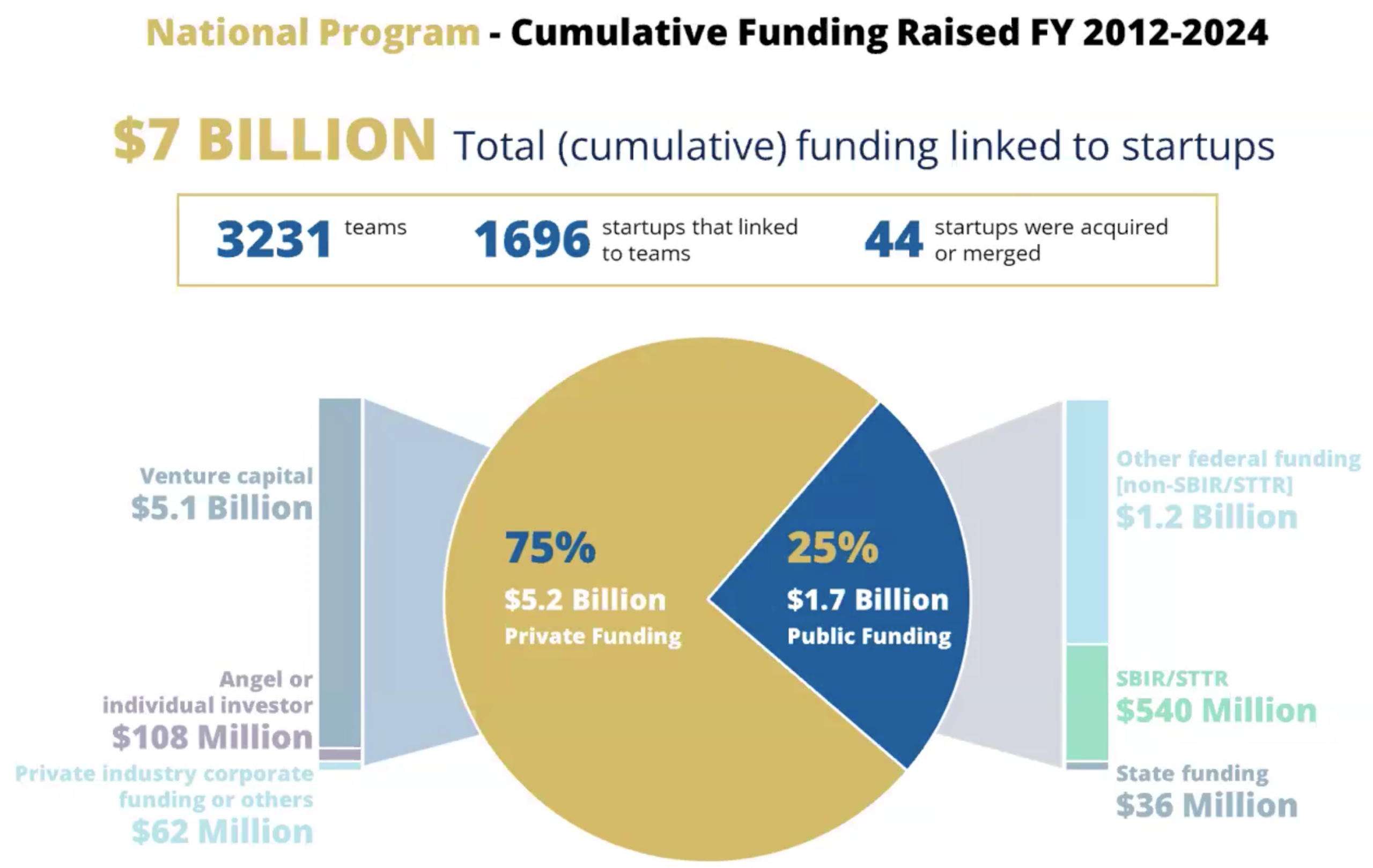
Over the past decade-plus, NSF I-Corps has built an impressive track record: since the program’s launch in 2012, more than 3,000 academic teams have gone through the program, roughly half have gone on to form startups, and those companies have collectively raised $7B in private capital and over $1.7B in public funding, including approximately $540M in SBIR/STTR awards. Dozens have already seen successful exits.
NYU has been an active participant in this story: more than 40 NYU teams from across Tandon, Arts & Science, Courant, Grossman, Dentistry, Steinhardt, Silver, and Nursing have completed NSF I-Corps, and many have gone on to form venture-backed startups, secure federal non-dilutive funding and/or raise venture capital. You can read success stories and learn more about the outcomes from NYU I-Corps teams in our Beyond the Bench blog post series.
What NSF I-Corps Is Really For
At its heart, I-Corps is about research translation: taking a novel technology that emerged from fundamental research and testing whether it can solve a real, valuable problem in the world. It’s not a grant to build your prototype; it’s a short, intensive program to help you decide whether it’s worth doing that at all.
The I-Corps Teams program not only provides rigorous training but also significant financial support. It pairs:
- A seven-week, fully virtual curriculum that provides the rigorous, structured framework to rapidly test market assumptions and make informed decisions about commercializing your research,
- And a $50,000 sub-award to the university to cover stipends, travel, and other program expenses.
In the process, you'll conduct at least 100 customer discovery interviews with customers, partners, and other stakeholders. These interviews are the real work of I-Corps. They’re how teams discover who really has the problem they think they’re solving, how those people talk about it, what else they’re trying, and whether the proposed solution is compelling enough to matter. Many teams end up making significant pivots in who they are building for, what they’re offering, or whether there’s a venture-scale opportunity at all.
As above, NSF has run this program for over a decade. Along the way, more than 3,000 teams have participated; about half have gone on to form startups that collectively raised billions in private and public capital. Reviewers in NSF’s SBIR/STTR program and private investors both recognize I-Corps as meaningful evidence that a team has done the work to understand its market.
The Deep Tech Focus: Who and What Belongs in NSF I-Corps?
NSF I-Corps Teams is not a general entrepreneurship program. It is very deliberately aimed at deep technology coming out of U.S. universities' research labs.
“Deep tech” in this context means:
- The technology is being developed at NYU (or another U.S. research institution). It’s not a side project you’re doing independently while you’re at the university. The work is part of the lab’s research agenda, with IP that has been (or should be) disclosed to the university’s tech transfer office (TOV).
- There is a real, defensible technical innovation. NSF is looking for fundamental advances in science and engineering. This includes novel materials or devices, new biological or chemical approaches, core algorithmic or systems innovations, etc.; not just an application that stitches together existing tools.
- It’s beyond the idea stage, but still early. Most teams have some sort of early prototype or strong proof-of-concept. You don’t need a polished product, but you should have more than just a slide deck. Further teams should have plans to publish their research to demonstrate efficacy of their technology in a lab setting.
- It’s more than “an app that uses AI.” This is a subtle but important point. A startup that simply applies off-the-shelf machine learning or generative AI tools to a new problem is not considered deep tech by the NSF. The bar is high: there needs to be something fundamentally new in the underlying technical approach, not just in the user interface or business model.
On the team side, NSF expects at least three core roles in the applying team:
- An Entrepreneurial Lead (EL): typically a PhD student or postdoc working directly with the technology in the PI's lab, who leads the team’s day-to-day work and does the presenting during the program.
- A Technical Lead (TL): usually the faculty PI or a co-inventor, who brings deep technical expertise and participates fully. Please note that to serve in this role, the individual must meet the eligibility requirements outlined in NYU’s Policy on Principal Investigator/Project Director Status, which generally includes tenured/tenure-track faculty and certain full-time research researchers.
- An Industry Mentor (IM): someone from outside the university with relevant industry or entrepreneurial experience and no direct financial stake in the technology, who can help the team navigate the commercial context.
All three are expected to attend every I-Corps session and participate in the full slate of interviews. The time commitment for the EL and TL often runs in the range of 15–20 hours per week during the active program, which makes planning around classes and teaching loads important.
How You Become Eligible: NSF Lineage and Regional Programs
To apply to the national I-Corps Teams program, it’s not enough to have a promising deep tech project and a motivated team. You also need to satisfy one of two eligibility pathways.
- NSF lineage: If you or someone on your team is a PI, co-PI, senior personnel, postdoc, graduate student, or professional staff on a relevant NSF research award that has been active in the last five years, and the I-Corps technology emerged from that award, you’re likely eligible. The connection has to be real and substantive. The technology can’t be unrelated to the grant, but the NSF is reasonably flexible about who on the award team can serve on the I-Corps team.
- Regional I-Corps Programs: NSF has designated a network of I-Corps Hubs across the U.S. that run shorter, regional versions of the program. NYU is a founding partner of the New York I-Corps Hub. If you complete a regional I-Corps course with your technology and perform well, the Hub may choose to give you a letter of recommendation. That letter, which must be uploaded with your I-Corps Teams application, serves as your eligibility in place of NSF lineage.
In practice, even teams that already have NSF lineage are increasingly encouraged to go through a regional program first. The national program has become more rigorous over time, and teams that arrive with some I-Corps experience tend to hit the ground running.
At NYU, our primary on-ramp to this regional pathway is Tech Venture Workshop at the NYU Entrepreneurial Institute.
Tech Venture Workshop: NYU’s I-Corps On-Ramp
Tech Venture Workshop is our way of bringing the I-Corps mindset and methods closer to home. It’s designed specifically for NYU faculty, postdocs, and graduate students who are working on potentially commercializable technology and want to explore whether I-Corps (and, eventually, startup formation and/or fundraising) might make sense.
Over the course of the workshop, teams:
- Clarify the underlying technology and the problem they believe it solves.
- Learn the basics of customer discovery and the Business Model Canvas.
- Get out of the building for early conversations with potential users, customers, and partners.
- Start to see how their research might map onto real market needs, or where it doesn’t.
- Access a $2,000 grant for customer discovery and prototyping expenses (reimbursement to their lab)
For many teams, the Tech Venture Workshop is the first time they’ve articulated who their customer might actually be and what that person cares about in their own words. It’s also where questions about deep tech eligibility, team composition (who should be EL, TL, IM), and timing for national I-Corps come into focus.
We align Tech Venture Workshop closely with the expectations of regional and national I-Corps so that the teams that want to keep going are well-prepared. Strong teams can then work with us and with our regional I-Corps Hub partners to pursue the letter of recommendation needed to apply to the national Teams program. We can facilitate an introduction to the NY I-Corps Hub once you have prepared your application's executive summary. Use our executive summary template guide to help prepare yours.
You can learn more about Tech Venture Workshop and see upcoming dates on the Leslie Entrepreneurial Institute website.
Planning Ahead from NYU
NSF currently runs 12 national I-Corps Teams cohorts each year: winter, spring, summer, and fall. Because of demand and the lingering effects of last year’s federal government shutdown, there’s now roughly a six-month lag between when a team applies and when they actually participate in a cohort.
For NYU teams, that means it’s important to think about I-Corps on the same time horizon you’d use for a major grant or a sabbatical: when in the next year would a seven-week, 15–20 hours-per-week commitment be realistic for your lab?
From there, a typical path looks like:
- Talk with us early. If you’re not sure whether your project qualifies as deep tech or what an appropriate I-Corps team would look like, reach out to sign up for a coaching session to sanity-check your thinking.
- Apply to the Tech Venture Workshop. Use the workshop to get your feet wet with customer discovery, sharpen your value proposition, and clarify how I-Corps fits (or doesn’t) into your broader research and commercialization plans.
- Apply to NSF I-Corps with enough lead time. Once your team and technology are ready, target a cohort roughly six months out, taking into account academic calendars, experiment schedules, and any upcoming SBIR/STTR or other funding applications.
I-Corps is not the right move for every project. But for NYU deep tech teams that are serious about understanding whether their research has a path to real-world impact, and what that path might actually look like, it remains one of the most efficient learning experiences available.
If you’re interested in exploring whether your work might be a fit, or how Tech Venture Workshop and I-Corps could fit into your lab’s plans, get in touch with the NYU Leslie Entrepreneurial Institute or take a look at the upcoming Tech Venture Workshop offerings.


