





In recent years, gene therapies that engineer a patient’s own immune cells to target cancer have emerged as cutting-edge treatments. However, high logistical hurdles and a lack of long-term remission have limited their impact. Enter OverT Bio, an NYU-incubated biotechnology startup founded by Dr. Neville Sanjana and Dr. Mat Legut. Sanjana is a professor of biology, neuroscience and physiology at NYU Arts & Science and NYU Grossman School of Medicine, and Legut was a former Hope Fellow in Sanjana’s lab at NYU and the New York Genome Center. Using a high-throughput genetic screening platform, OverT aims to develop scalable, curative therapies that overcome these historical bottlenecks.
OverT’s Genetic Screening Platform
Combining revolutionary cell engineering technology with a big data approach, OverT analyzes thousands of genes in human immune cells to isolate the ones that make the best therapies in the face of tumor immunosuppression. They are the first to use patients’ immune response to cancer to find new receptors that can be applied across populations, making for greater access. “These new types of immune therapies can potentially cure patients even with late stage disease,” Legut explains.
“The foundation of the science is something called the chimeric antigen receptor (CAR) T-cell. It has great curative benefits but involves getting the patients in to give immune cells and wait on an expensive and complicated individualized manufacturing process. What we set out to do is still use that unique curative potential but also make them at scale to reduce cost and widen adoption.”


Targeting Solid Tumors
Historically, CAR T-cell therapies have mainly been deployed to treat blood cancers but OverT’s radical approach of adding modifier genes to T-cells in order to supercharge their cancer-killing abilities shows great promise against solid tumors.
“The question we were asking was simple but profound,” Sanjana explains. “What genes, when you turn them on in T-cells, transform them into superior cell therapies that navigate the challenges posed by solid tumors?” This approach represents a new frontier in cancer treatment. “The market gap we’re filling is the treatment of 95 percent of cancers,” says Sanjana. “Our lead cell therapy program, OVT-101, is going after ovarian cancer,” adds Legut. “It’s the leading cause of mortality in gynecological cancers and usually gets diagnosed very late. At that point, chemotherapy and surgery do not offer much curative potential. Our vision, by contrast, is a durable cure, something you take once and remain cancer-free for the rest of your life.”
From Lab to Market
OverT’s story began with Legut and Sanjana meeting at a UK conference in 2018. “I was working on cell therapies and really interested in Neville’s pioneering approach, testing genes to find new targets,” Legut recalls. “One conversation and a few months later, I moved across the pond to join his lab and we started working on what would become our foundational IP.” From that point onward, NYU and the New York Genome Center were to play an important role in the company’s genesis. “We are an NYU company,” Sanjana says. “This wouldn’t have been possible without their support. It’s the kind of thing that’s very unlikely to come out of big pharma.” Sanjana credits Legut for his early conviction that their research be spun out into a startup. “From almost day one, Mat was determined to make a real world impact and make sure that we were the ones to bring it to clinics,” he recalls. “There’s a real emphasis these days on scientist founders and that’s great but it’s a real learning experience because starting a company requires different skillsets from doing science in a lab.”
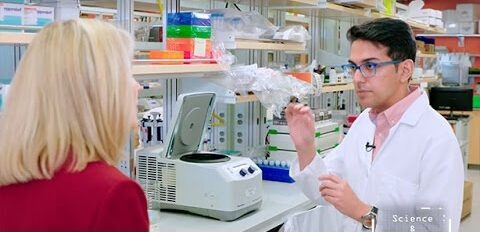
Fortunately, NYU’s infrastructure, both human and otherwise, helped bridge that gap and catalyze their entrepreneurial intent. “They provided the resources and the lab space, the vivarium for all of our animal work,” Sanjana says. “But also, so many of our co-authors and collaborators emerged from the NYU ecosystem.” Catherine Diefenbach, one such key collaborator, came from down the street at NYU Langone where she’s a hematologist-oncologist. She played an instrumental role, particularly in managing clinical trials. “She was so crucial to getting the company off the ground and her clinical experience has been invaluable,” Sanjana adds. “She’s been deeply involved on both the science side and as one of our most vocal supporters.” “It was important for us to have clinicians who actually use CAR T-cells to treat patients to look at our science and validate it,” Legut says. “Collaborators like her give two guys working in a lab on something no one cares about the confidence that it could have real clinical impact.”
Operating within this supportive framework, the team incorporated OverT in August 2022 and closed its first round of VC funding in March 2023. Three years and 16 million dollars in seed funding later, the company is booming. “We just nominated our development candidate for that lead program in ovarian cancer and are planning for in-patient deployment next year,” Legut says. “We are raising our next round series to power that development.”
We're using a specialized set of T-cells called gamma-delta T-cells that are natural receptors and we can use them to discover new targets on cancer cells. This is unique to OverT - there’s nothing like this out there.”
Dr. Neville Sanjana
The Future of Cell Therapy
Meanwhile, OverT’s roadmap focuses on three distinct strategic pillars. “The first is moving through clinical development of the lead program and expanding it to other cancer types like endometrial and lung cancer,” Legut explains. “We’re building toward having multiple biologics ready to go at clinics that can span multiple solid tumor indications. Scalability is the guiding principle.” The second pillar involves working with T-cell engagers, molecules that direct the body’s immune system to target tumor cells. “Most T-cell engagers today focus on using antibodies to detect specific antigens on the tumors,” Sanjana explains. “We're using a specialized set of T-cells called gamma-delta T-cells that are natural receptors and we can use them to discover new targets on cancer cells. This is unique to OverT - there’s nothing like this out there.” The final pillar involves perfecting in-vivo cell therapy, engineering cells directly inside the patient’s body. “Instead of modifying cells in a lab, what if we have something ready to go same-day for patients that does what the first program does–modify T-cells–but do it directly in-vivo,” Sanjana says. “It’s something a lot of pharma partners are excited about.” OverT is on its way, for all intents and purposes, to being three companies in one, a development the founders are excited about. “What unites everything,” Sanjana explains, “is that the future is clear on cell therapy being the game-changer for cancer treatment but none of it will happen unless it scales differently. That’s what we’re aiming to achieve.”


