





Beyond the Bench is an ongoing series highlighting NYU faculty and researchers who are turning their research into real-world ventures. Read the full series here.
Ever since the launch of text-to-image models like DALL-E and Midjourney, AI image generators have entirely upended the information ecosystem. As AI images flood the world and the resulting epistemic crisis builds, there’s an escalating need for tools to check the veracity and origin of digital assets while helping institutions protect their intellectual property from manipulation. Eric Wengrowski, a former postdoctoral researcher at NYU Tandon, has taken up that challenge with Steg.AI, a startup that uses machine learning to cut through the digital noise.
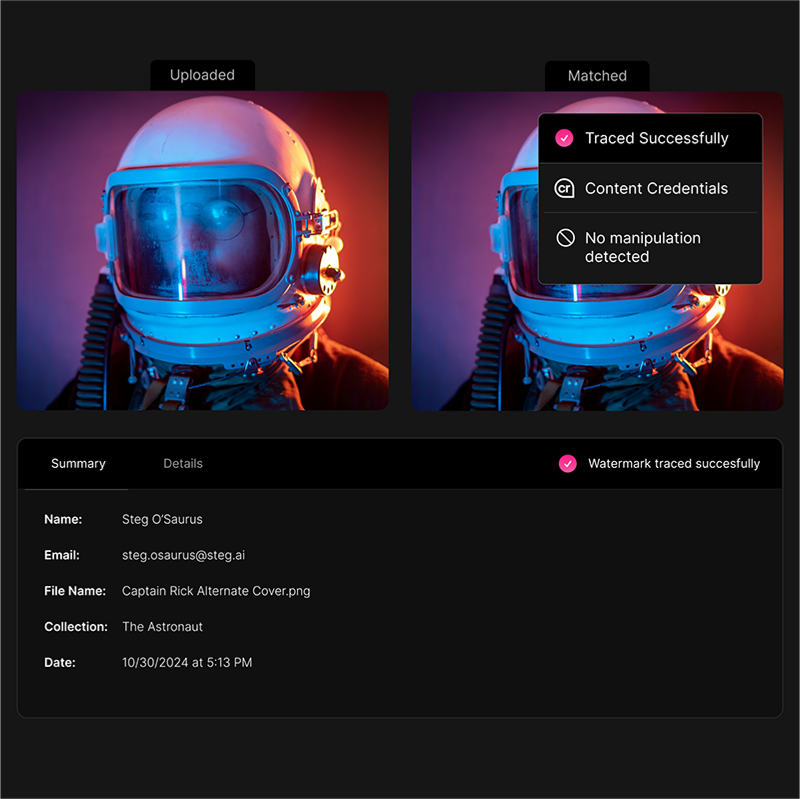
“The main thing we work on is a technology called steganography or forensic watermarking and that's where the Steg in our name comes from,” Wengrowski explains. “This involves making imperceptible changes to the pixels of an image, video or really any digital file in a way that’s invisible to humans but that our algorithms are sensitive to.” These files look unaltered to the human eye but Steg’s proprietary software can detect the steganographic watermark and track them back to their source. Unlike standard visible watermarks, Steg’s mark is embedded in the file’s code and cannot be removed or cropped out and will, in fact, remain detectable even in a photograph of the original image. “Our tech encodes information, often about an intended recipient or what you're allowed to do with a file or where it came from,” Wengrowski adds. “It’s abstracted away from humans and only another machine learning model can read it down the line.”
Customers can access the technology via a web app, APIs or even an on-premises software development kit for those with high security requirements. Steg does, in fact, have multiple such clients with a lot riding on data security. “Our first enterprise customer was Sonos and they use us to protect all creative marketing assets,” Wengrowski says. “We work with companies like Funko that do a lot of licensing in the toy space. We work with some of the biggest tech and consumer electronics companies. And we also work with movie, TV and game studios and other entertainment media.” Some clients utilize Steg.AI tech for copyright protection, tracing the path of trademarked imagery and preventing theft. Others, like AI image generating companies, use it to track whether an AI image has been used as a deepfake or to commit crimes and to quickly contain any fallout by confirming it’s a fake. “Our customers can't afford to get it wrong - they need a technology like ours that will tell them with complete accuracy, hey, where did this thing come from,” Wengrowski explains. “Did this come from your organization or is this synthetic media that you created and somebody else manipulated?”
Steg.AI began with Wengrowski’s PhD work at Rutgers University on steganography, then a niche technology for tracking the path of images across the internet. With the encouragement of his advisor, he and a group of co-founders formed the startup and got off to a strong start with participation in the winter 2019 cohort of the NSF’s I-Corps program. “At I-Corps, we did customer discovery and got rid of all the ideas that we realized, through testing, were bad,” he recounts. “We stress tested all the ideas we had for product market fit and, through process of elimination, pivoted the direction of the company a lot in that time.” As always with I-Corps, much of that iterating was done by getting out of the lab. “We learned by talking to people, at places like Getty and Adobe, figuring out what the actual commercial need was,” he adds. “We got feedback on use cases for the technology and started mapping how we could solve those problems. We went from thinking about using watermarks as something people could use for interacting with their TVs to helping social media companies combat piracy and copyright theft on their platforms.”
I-Corps also turned out to be an invaluable networking opportunity. “We had to do a minimum of a hundred interviews and it really gives you time to put your foot in the door at some of these places,” Wengrowski recalls. “We met great people who would later come to work for the company and also some of our biggest champions in the investment and customer worlds.” The program also taught them how to parse and navigate a business environment. “I’m an engineer so I didn’t know what business people did, what value was brought by the people who weren’t technical,” he says. “I was connected to mentors who gave me appreciation for that style of work, identifying certain kinds of business-side problems, learning how to talk to customers, truly fundamental stuff.”
The subsequent momentum and confidence led to successful applications for non-dilutive funding from SBIR grants as well as a postdoctoral research position at NYU Tandon’s Media Forensics Lab. It was at this point that Wengrowski crossed paths with the NYU Entrepreneurial Institute. “Frank Rimalovski and team decided to invest in Steg through the NYU Innovation Venture Fund,” he explains. “They also made for excellent partners, connecting us to great people and ideas. The network helped us raise funds, build out the product and mature as a company. I highly recommend.”
This solid foundation has helped Steg.AI grow in leaps and bounds ever since, attracting their large set of powerhouse clients. “We were pretty far ahead of the market,” Wengrowski says. “I used to talk about this thing called the deepfake and how it’s coming soon and people’s eyes would glaze over. But then it happened and when even the White House started calling watermarking tech a potential solution, we got attention because we were ahead of the curve.” The list of near-future goals is a long one. “We’re fundraising so we can sustain this growth stage,” he says. “We’ve got our first customer for Deepfake Shield and working on more. We’re taking continued innovation seriously, creating new science, productizing it and taking it out of the lab to battle test it with customers. And we’re growing our team - bringing on more scientists, more engineers, more business development people because it’s all gotten too big for just us. Finally, we want to get to a stage where for every piece of media you put out there, we want to be watermarking so you know it's yours, so you know where it goes, who's manipulating it. At the end of the day, truthfulness, trust and privacy are the core business values we want to bring to everybody.”


