





In our recent I-Corps posts we focused on discovery & testing whether your deep tech solves a real-world problem. Here we focus on what comes next: SBIR/STTR and the 2026 reauthorization. The timing couldn't be better: the Small Business Innovation and Economic Security Act was reauthorized on April 13, 2026, extending the SBIR/STTR programs through 2031! 🎉
If you are currently participating in NSF I-Corps or planning your next steps, here is what you need to know about the evolving federal funding environment and how it ties into the work we’ve been discussing.
NSF I-Corps to SBIR Bridge: Stronger Than Ever
One of the most exciting updates from the webinar is the expansion of TABA (Technical and Business Assistance). Agencies can no longer limit TABA to pre-selected vendors, and statutory ceilings have been codified at 6,500 for Phase I and 50,000 for Phase II.
Crucially, TABA funds can now be used explicitly for NSF I-Corps participation. This reinforces what we’ve said in prior posts: the customer discovery you do in I-Corps is not just a checkbox; it is the foundation of your SBIR commercialization plan. Reviewers at the NSF and other agencies increasingly recognize I-Corps as credible evidence that a team has done the work to understand its market.
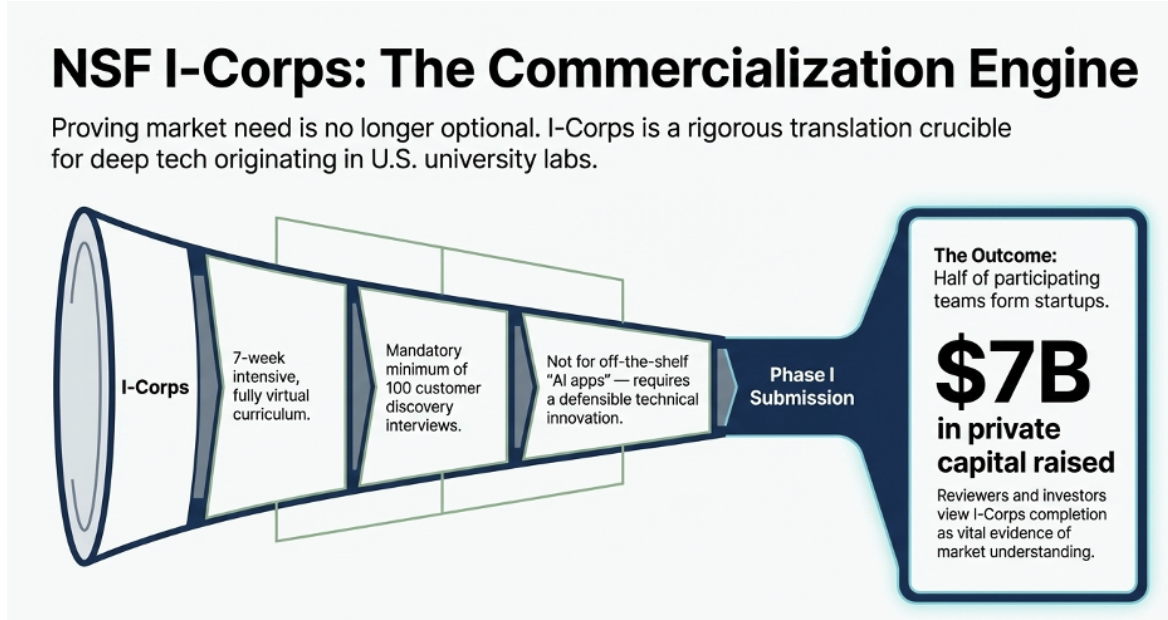
The "Science vs. System" Hurdle in NSF Project Pitches
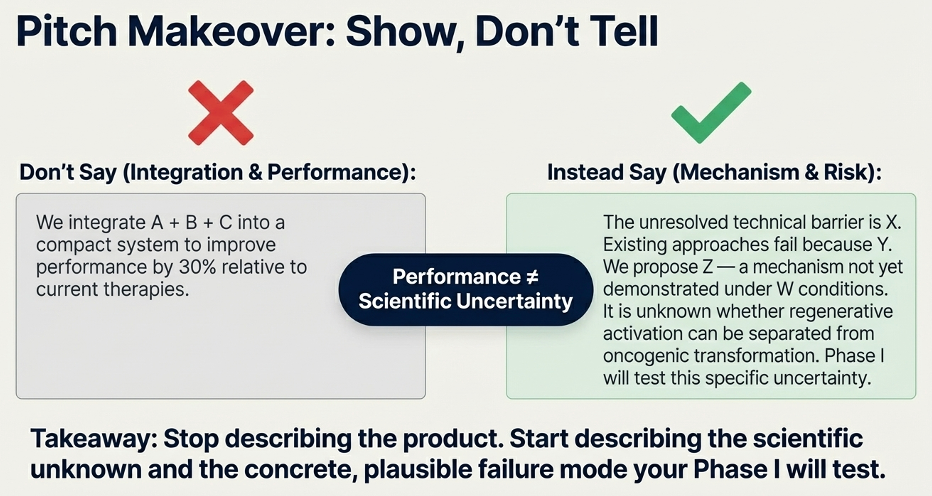
As we discussed in our recent post about the I-Corps Executive Summary, the NSF has a very high bar for "Intellectual Merit". This is even truer for SBIR Project Pitches in 2026. Because of a flood of AI-assisted drafting, the NSF is aggressively screening out pitches that describe product development rather than high-risk innovation.
A common mistake is describing a system (integrating A + B + C to improve performance) instead of the science. To get invited to submit a full proposal, your pitch must argue why the science might fail and how your Phase I experiment will resolve that technical uncertainty.
For example, instead of a system-focused pitch that says:
"We are developing a minimally invasive cardiac monitoring device that integrates a flexible biosensor, a microfluidic sampling channel, and a wireless module to improve patient performance".
You must pivot to a science-focused pitch that identifies a clear technical barrier:
"Continuous in vivo biochemical monitoring currently fails due to rapid biofouling under physiologic flow. We propose a self-renewing electrochemical interface designed to prevent protein adsorption—a mechanism that has not yet been demonstrated during multi-day implantation".
By focusing on the unresolved technical barrier (biofouling) and the scientific uncertainty (multi-day stability of the interface), you demonstrate the high-risk innovation that the NSF is looking for in 2026.
New Opportunities: Strategic Breakthrough Awards
For teams moving beyond Phase I, the new legislation introduces Strategic Breakthrough Phase II awards. These are massive grants—up to $30M over four years—designed to bridge the research-to-practice gap. These awards require a 1:1 capital match from private or non-SBIR federal sources and are reserved for technologies that advance national security or transformative capabilities.
What This Means for NYU Researchers
- Don’t wait. Start your proposal technical narratives now, before everyone else..
- Focus on Quality. With new submission caps (20 Phase I and 20 Phase II proposals per company per year), agencies are prioritizing high-quality, high-risk technical leaps over high-volume submissions.
- Audit Your Affiliations. There is a new, intense focus on foreign risk and due diligence. Be prepared to be transparent about your capital structure, licensing agreements, and any foreign affiliations of key personnel.
- Leverage NYU Support. Whether you are transitioning from the Tech Venture Workshop or preparing an NSF pitch, the Leslie Entrepreneurial Institute is here to help.
If you're wondering whether your project meets the "deep tech" standard for these new funding opportunities, we encourage you to sign up for a coaching session with our team. We can help you sanity-check your technical innovation and align your project with agency priorities.
Save the date for: Navigating Federal Funding: SBIR/STTR Workshop with Jim Greenwood on May 6, 2026. This workshop is designed to help you prepare for the new landscape. Attendees will also be able to apply for 1:1 SBIR-STTR consulting with Jim Greenwood to get personalized guidance.
For NYU researchers that have already completed the NYU Tech Venture Workshop and are thinking ahead to the next step after NSF I-Corps, the NYU Tech Venture Accelerator (TVA) remains a key bridge from discovery to commercialization. As the third phase of the NYU Tech Venture Program, TVA is designed to help teams translate research into scalable ventures by advancing customer pilots, early revenue, and readiness for SBIR/STTR funding and/or venture capital. We are currently planning the next TVA cohort for Fall 2026/Winter 2027, with the exact application deadline TBA. If you are interested in participating, we encourage you to let us know in coaching!
Related Reading:


