





You have an idea. That’s the first, most exciting step. And because this is 2026, your first instinct is probably to turn to the easiest, fastest, and smartest partner you know: AI. Stuck on a name? Ask AI. Need a pitch deck draft? Ask AI. Wondering who your ideal customer is and what they actually care about? Just…ask AI?
Not so fast.
AI is an incredible tool that can help you move from a blank page to a strong starting point in minutes. But it’s a terrible replacement for the one thing that has always been non-negotiable in entrepreneurship: You still have to get out of the building and talk to real humans. As we first detailed in the original guide, Talking to Humans, a founder’s most critical task is to reduce uncertainty by directly engaging with potential customers. This principle holds true, even, or especially, in the age of AI.
In the age of AI, your advantage isn't having more information; it's having better insight. And that insight still comes from live conversations. AI, used well, can actually make you a better listener, a sharper thinker, and a faster learner. Let’s unpack how.
Hypotheses First, AI Second: Turning Your Guesses Into Facts
Right now, your startup is built on a foundation of educated guesses, or what we call hypotheses. Who is your customer? What's the problem? How will you create value?
Here’s a stat we see consistently: more than half of your first guesses are wrong. You can assume that roughly 60% of your initial hypotheses will not hold up once you start talking to real customers.
That’s not a failure. It’s the entire point.
The process you’re starting now, customer discovery, is simply the system you use to test those guesses with real people and reduce your risk. Whether you use the Business Model Canvas, a Lean Canvas, or just a notebook, your job is to write down your best guess, then go out and test it.
Where does AI come in? AI is a fantastic thought partner at the hypothesis stage:
My solution is X, the problem I think I’m solving is Y. Who might be my early adopters?What other customer segments might care about this problem that I’m not seeing?What might be their jobs-to-be-done, pains, and gains?
In a recent Startup Bootcamp workshop I led, a founder who thought only about “urban farms and community gardens” discovered that AI surfaced “small restaurants and cafes” and “urban apartment buildings” as plausible customer segments they hadn’t considered.
Did that make AI “right”? No. It broadened the founder’s thinking. It gave them more hypotheses to test with real people.
That’s the correct order in the age of AI:
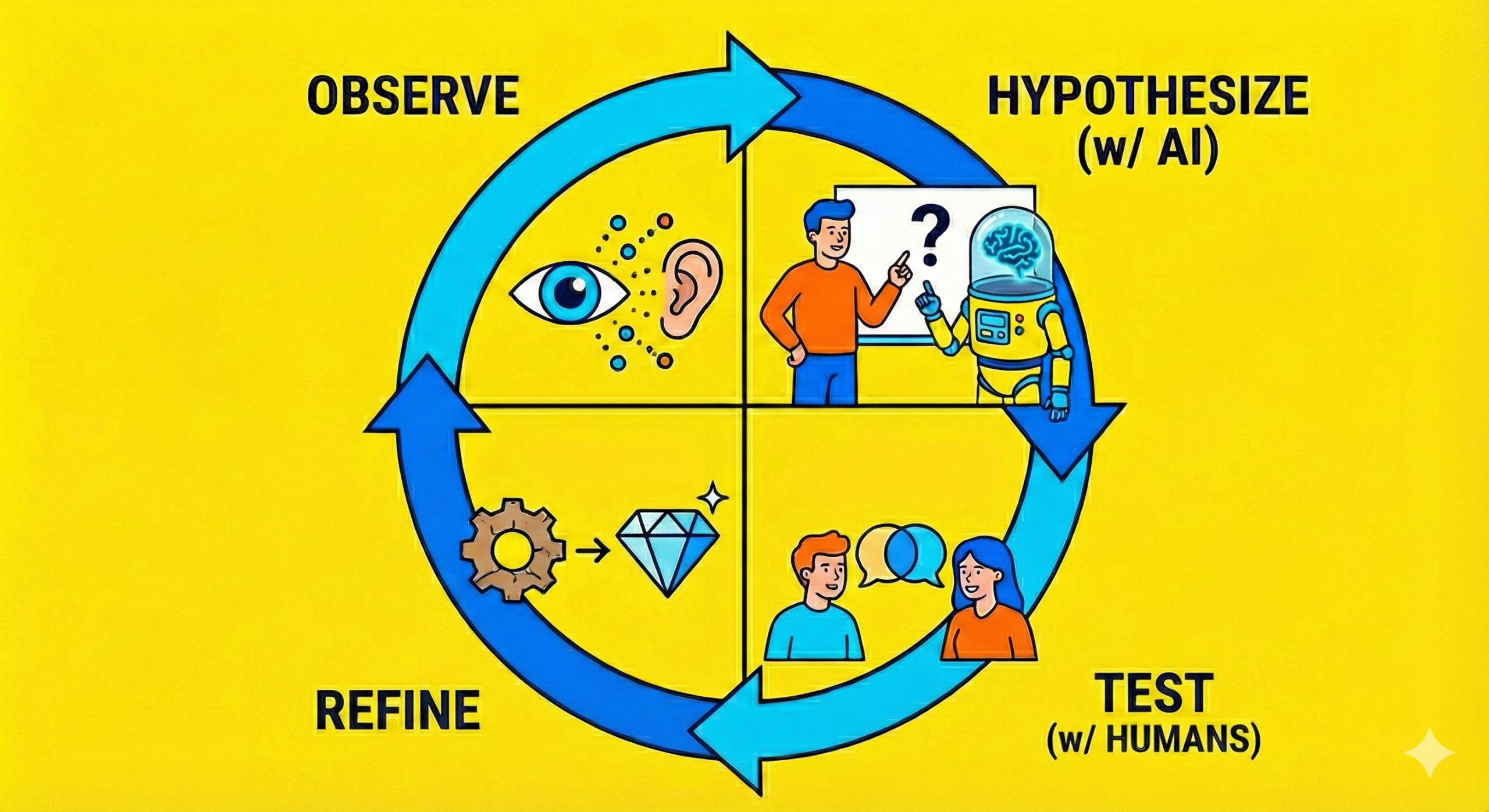
AI should improve your starting point, not replace the journey.
Why You Still Need to Talk to Strangers
No matter how good the model, AI is trained on what’s been written, not on the tacit, messy, emotionally charged realities of your specific customers in their specific context.
Your job as a founder is to:
- Understand how a real radiologist hands off a case at 2 a.m.
- Watch how a busy nurse gets through a shift change with three competing priorities
- Listen to a parent explain why they picked that toy, in that store, on that day
AI can help you describe a “typical” user. It can’t replace the subtle nonverbal cues, contradictions, and workarounds you see and hear when you sit across from an actual human being.
That’s why, even now we tell founders: In‑person is best. Zoom is a strong second, and phone, email, and text are poor substitutes, when you consider that roughly 60–80% of human communication is nonverbal. If you’re doing customer discovery in a chat window or worse an email, you’re flying blind.
In the age of AI, your edge is not having more information; it’s having better insight. Insight still comes from conversations, not just content.
Using AI as Your “Third Co‑Founder”
Where AI really shines is as an always‑available, unembarrassable co‑founder who will brainstorm with you at 2 a.m. and never gets tired of dumb questions.
Some practical ways to use it:
1. Clarify your early adopter: Prompt AI with:
I am at the early stages of developing a new startup concept. My solution is ______. The problem I’m trying to solve is ______. Generate 3–5 plausible early adopter segments and explain why each might care.
Then, continuing, ask AI:
Which segment is *most likely* to have an urgent, unmet need?What signals might show they are *actively seeking* a solution?
You don’t take the answer as gospel. You use it to sharpen your own point of view.
2. Design better interview guides: Once you’ve articulated a customer segment and problem hypothesis, use AI to help generate open‑ended questions that help you test your riskiest assumptions:
What are good questions to test whether [segment] experiences [problem] acutely and is trying to solve it today?Give me questions focused on past behavior, not speculative future opinions.
You still need to edit ruthlessly. Remove leading questions. Strip out anything that sounds like a pitch. But AI can get you to a strong draft much faster.
3. Find creative recruiting channels: Recruiting people for customer discovery interviews is often where founders struggle. You know who you want to talk to; you just don’t know how to reach them. Ask AI:
My target customer is ______. Where do they spend time online and offline? Suggest specific tactics to find and recruit them for 20‑minute customer discovery interviews.
It might suggest LinkedIn filters and titles to search for, niche Reddit or Discord communities, professional associations and conferences or physical “fishing holes” (e.g., Whole Foods for almond milk buyers, hospital corridors for radiologists)
Then you go do the hard part: actually reaching out, asking for 15–20 minutes, and being prepared for a lot of no’s.
What AI Cannot (and Should Not) Do
There are some things you should resist the temptation to outsource to AI.
1. The conversation itself: Customer discovery interviews are not surveys. They’re not multiple‑choice forms you can automate.
They are live, messy conversations, full of detours, emotions, and contradictions, where you follow-up “Why?” questions matter more than your first question.
If you hand that off to a bot, you don’t just risk bad data. You lose the learning experience that shapes your own intuition as a founder.
2. The hard emotional work: Good customer discovery is uncomfortable. It provides a framework to not receive the answer that you want or that you think you might get, but the true answer that exposes a real problem that someone's facing.
You’ll hear that your assumptions are wrong. Your “brilliant” idea might not matter to the people you wanted to serve.
As John Maeda put it: "It’s grueling listening to customer feedback. If it isn’t, you’re probably doing something wrong."
No amount of AI will spare you from that. Nor should it. That discomfort is exactly where you grow as a founder.
3. The strategic judgment calls: AI can help you generate options: Should I focus on segment A, B, or C first? What are the trade‑offs between these beachhead markets? But you decide where to put your scarce time, money, and energy.
Pivots, the small, targeted changes in your business model (customer, problem, value proposition, channel, revenue model), are judgment calls. You can invite AI into the discussion, but you shouldn’t abdicate the decision.
Practical Guidelines for Founders Right Now
To make this concrete, here’s how I’d suggest using AI in your next few weeks of customer discovery:
- Define your first beachhead with AI’s help
- Ask AI for several candidate early adopters
- Pick one to start with, knowing you’ll probably pivot
- Draft your outreach and interview guide with AI
- Generate a brief, non‑salesy outreach email (15–20 minutes ask, no pitching)
- Generate 10–15 open‑ended questions focused on past behavior
- Edit them aggressively
- Do the interviews yourself (ideally in pairs)
- One person leads, one takes notes
- Turn on your observational radar: tone, hesitation, emotion, workarounds
- Wind them up with a good question, then be quiet
- Synthesize with AI as a thinking partner, not a judge
- After 5–10 interviews, summarize your notes
- Ask AI:
What patterns do you see? What might I be missing? What alternative explanations are there?Decide yourself what to keep, change, or throw out
- Repeat the cycle
- Refine your hypotheses
- Adjust your customer segment, problem definition, or value proposition
- Design the next round of interviews
If you do this well, AI won’t make you skip customer discovery, it will help you do more of it, better, faster.
The Paradox: AI Makes Being Human More Valuable
Thanks to AI, we’re in a moment where almost anyone can spin up a landing page, a logo, a pitch deck, a “customer persona”, or even an application in a weekend.
None of that answers the only question that really matters: Does this thing actually solve a real, meaningful problem for a real customer?
What’s scarce now isn’t content, code, or clever branding. It’s evidence:
- Evidence that the problem you’re focused on is painful, frequent, and important
- Evidence that customers are already spending time or money trying to solve it
- Evidence that your solution meaningfully improves their life or work compared to what they do today
AI can help you articulate a problem. It can help you imagine a solution. But it cannot tell you, with any credibility, that your hypotheses are true.
That only comes from repeated conversations with real customers, where you dig into their stories, their constraints, and their trade‑offs, and are willing to change your mind when the evidence tells you to.
Customer discovery in the age of AI is still about the same thing it has always been about: reducing uncertainty around whether you’re building something that truly matters to someone. AI just gives you better starting points and faster iterations as you do that work.
You still have to get out of the building. You just don’t have to go out empty‑handed.


