





The abuse of drugs both legal and illegal remains one of 21st century America’s defining public health crises. Tens of thousands die annually from overdoses each year and many more are affected by resulting chronic health conditions or societal ripple effects. A major bottleneck in combating this crisis has been the lack of accurate diagnostic tools that can be used easily in the field to detect the presence of multiple drugs. Portable Diagnostic Systems (PDS), a bio-tech startup that leverages microfluidics and AI to provide lab-quality testing at point-of-care, is stepping in to fill that void.
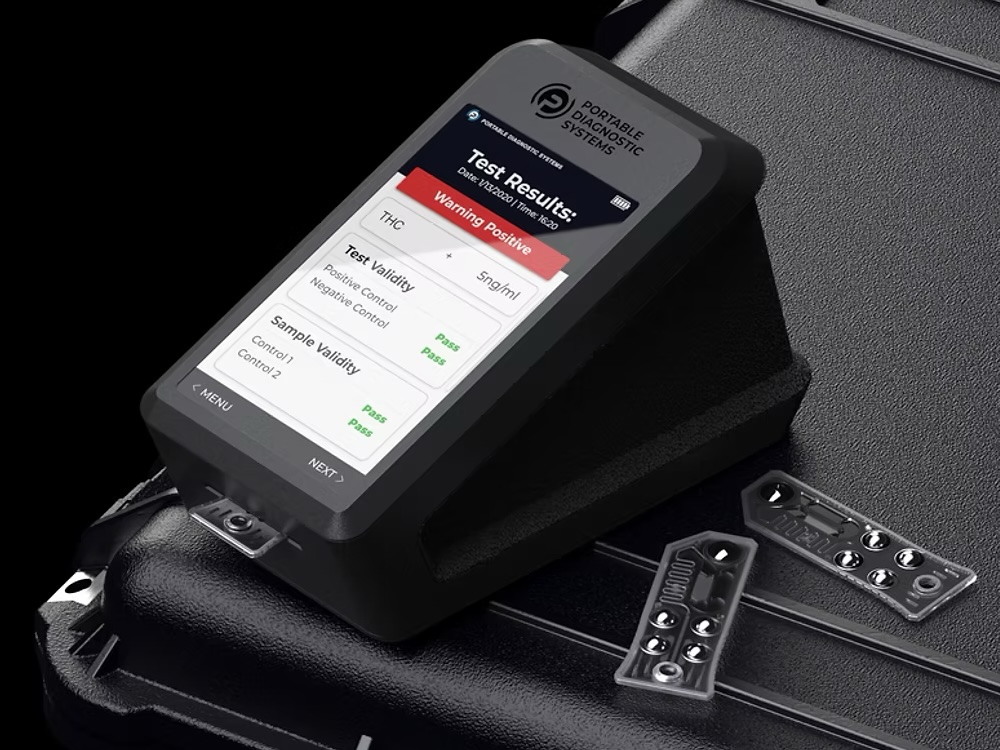
“There were few technologies that could screen for multiple drugs in the field,” recounts Glennon Simmons, co-founder/CEO of PDS and former staffer at NYU’s McDevitt Lab. “We saw a compelling need in forensic toxicology and drug testing capability because of a lack of innovation in that space and wanted to address this problem.” PDS’s solution is a lab-on-a-chip setup called the Integrity-1 Analysis System - consisting of an instrument, sample kit and cartridge. The cartridge, once loaded with a fluid sample, is inserted into the instrument which then provides a reading on a screen. “It weighs about two pounds, looks like a label printer and is designed to be used like a card reader,” says Simmons. “It works off immunoassays by using antibodies that bind to target antigens, in this case, a drug of abuse.” The antibodies compete with any drugs in the sample and if there's none present, show up bright on a fluorescent sensor. If drugs are present, they reduce the antibody signal proportionate to their concentration, showing up dimmer on the sensor.
The core ideas and early work behind PDS came about while Simmons was still working at Dr. John McDevitt’s lab at the NYU College of Dentistry. “I did a lot of diagnostic device development using microfluidics while working with him,” Simmons recalls. “I started working on generating pulsatile flow with membranes, the tech that became the basis for PDS, but it’s also where I caught the entrepreneurship bug.” PDS was formed as an LLC in 2019, after which Simmons started working through the provisional patent and licensing agreement with NYU while also entering the entrepreneurship ecosystem. “I came in as a scientist and didn't know anything about starting a business,” he recounts. “But then I met Frank Rimalovski, immersed myself in various programs with the Entrepreneurial Institute and was amazed at what I learned. They emphasize getting out of the building and learning directly from customers so that’s what first led me to the Tech Venture Workshop.”
As with many founders before him, the workshop is where Simmons started figuring out his customers’ specific pain points. “This is where I learned which markets had the ‘hair on fire’ problem, as the Institute team puts it,” he says. “I started doing customer interviews and quickly discovered from talking to, for example, law enforcement that forensic toxicology and not the wider diagnostic testing industry is where I needed to enter first. That’s when I settled on building out the product the way I did.” A big takeaway from the workshop was realizing that customer discovery never ends - “I’d just scratched the surface and left knowing I needed to do this way more and not just talk to police but also other people in the ecosystem, whether it’s toxicologists, government funding sources, agencies like the National Highway Traffic Safety Administration, policymakers.”
The NSF’s I-Corps program–the next step on the NYU entrepreneurship track–proved to be the ideal setting for Simmons and team to expand the scope of these interviews while also investigating potential markets. “I-Corps is where I mapped the market ecosystem,” he says. “We looked at potential segments to enter and looped back to the law enforcement market as ideal for launch with others following close behind. This is because our investigation identified drug recognition expert training schools as a niche segment we could enter early as a startup without having to manufacture at scale. They are empowered to make immediate decisions, have discretionary funding, lack regulatory hurdles and–most of all–need the product.” Simmons credits I-Corps with helping provide the tools and research framework needed to make this crucial pivot. “We’d been heading toward this realization leading up the program,” he recalls. “But I-Corps made the launch plan crystal clear because it taught us to consider the right data points, stuff like regulatory frameworks, management structures and market gaps.”
With launch strategy coming together, PDS earned a spot in the inaugural 2023 cohort of the Tech Venture Accelerator. The theme here was looking inwards at management and monetization. “At TVA, the emphasis was on objectives and key results (OKRs) and value inflection milestones, a system of management I hadn't used before,” says Simmons. “OKRs move the needle for the company, cutting through the clutter, identifying priorities and building a proper roadmap - probably the most impactful thing I came away with from TVA.”
It was not, however, the only takeaway. “The other thing was being able to keep pitching every week and get really helpful feedback every time. This helped us get a significant amount of non-dilutive funding and left me well prepared to raise a seed round.” Simmons had proved adept at attracting non-dilutive funding even before participating in TVA. Successful proposals included SBIR Phase I and Phase II grants, money from the New Jersey Commission on Science, Innovation and Technology, as well as two awards from challenges issued by the National Institute on Drug Abuse. “I’d credit this to years of contributing to grant proposals and seeing how the research team within the McDevitt lab wrote them,” he explains. His advice? “Putting your bottom line up front and having a good writing strategy is the winning combo.”
The money is earmarked for a variety of forward-thinking endeavors. PDS’s device is on its third generation prototype and already being used in paid pilot testing programs as the team works toward safety-oriented design improvements. And 2026 is shaping up to be a big year. “We hope to build our fourth generation device for customer rollout,” Simmons reveals. “We will also be writing grants for indications of use beyond drug testing. Those funds will be used to develop tests on the same platform we’re using now, looking at general wellness, maternal and infant health applications, even cardiovascular disease diagnostics. Thanks in part to the NYU Entrepreneurial Institute, I know exactly what ingredients I need to put together for an award-winning recipe and now we’re looking to execute.”


