





In just a few weeks we are kicking off our Startup Sprint, a two-week intensive to accelerate 18-20 high growth startups at NYU. Every Startup Sprint team runs 50 customer interviews during the program, that’s roughly 900 conversations across this cohort. But the number of interviews has never been the hard part. The hard part is knowing which questions to ask next and which assumptions to focus on. What a team needs to learn shifts every week, sometimes every day.
The founders who do customer discovery well keep a living map of their most critical assumptions, and design each interview to validate or kill them. The most sophisticated founders we coach are already using AI to close the loop between what they hear and what they ask next. But most teams are not, and the gap is widening by the month.
So this Sprint, every team gets the same infrastructure the best founders build for themselves.
Building on the Leslie Copilot
This is not the first piece of AI infrastructure we have put in founders' hands. In September 2025, the NYU Leslie Entrepreneurial Institute launched the Leslie Copilot, an AI coach built to ask every Startup Bootcamp team the sharp, structured questions a good coach would. It helped us scale the Bootcamp from supporting 65 ventures a semester to >400 teams without thinning the quality of support.
Our new Sprint AI tools pick up where the Bootcamp Copilot leaves off. With 50 interviews per team during the Sprint, that requires a different layer of AI support, one built for volume, synthesis, and the iterative loop between what founders hear and what they ask next.
The tools are already in the best founders' hands
Ask any investor which founders stand out right now and the answer is consistent: They build on a unique insight that goes beyond product-market fit, a view of the market that others have not reached yet. And they use AI to help generate those insights faster than the founders around them.
Look at how they work and you find the same pattern. They have a Notion or Airtable setup for interview capture. They have Claude or ChatGPT connected to their workspace. They have learned, through trial and error, how to prompt, how to structure context, and how to turn raw transcripts into decisions within hours instead of weeks.
That competence is not innate. It is a setup problem and a methodology problem, and most founders never get past the first week of figuring it out. The onboarding cliff is steep, the deadline is real, and the default is to fall back to sticky notes and gut feelings.
What every Sprint team gets on Day 1
At the Leslie eLab, we are closing that gap at the start of the program, not the end. Each of the selected ventures gets a pre-built Notion workspace that handles transcription, per-interview analysis, and a living record of their assumptions and learnings. Sitting on top of it is Claude, configured as the strategic reasoning layer across all 50 interviews: pattern analysis, assumption tracking, question revision, workshop synthesis.
We really need to create a centralized mind within our own team just so we can really be on the same page with our understanding of the problem and therefore our vision of the solution.
— David Cui (Agora), on why they built a shared context layer.
The Leslie eLab's discovery methodology is encoded directly into the tool as custom skills, so founders run one command rather than crafting prompts from scratch. Four skills cover the core loop: analyze a single interview, synthesize across a batch, revise the question bank as the team learns, and turn raw workshop notes into structured context.
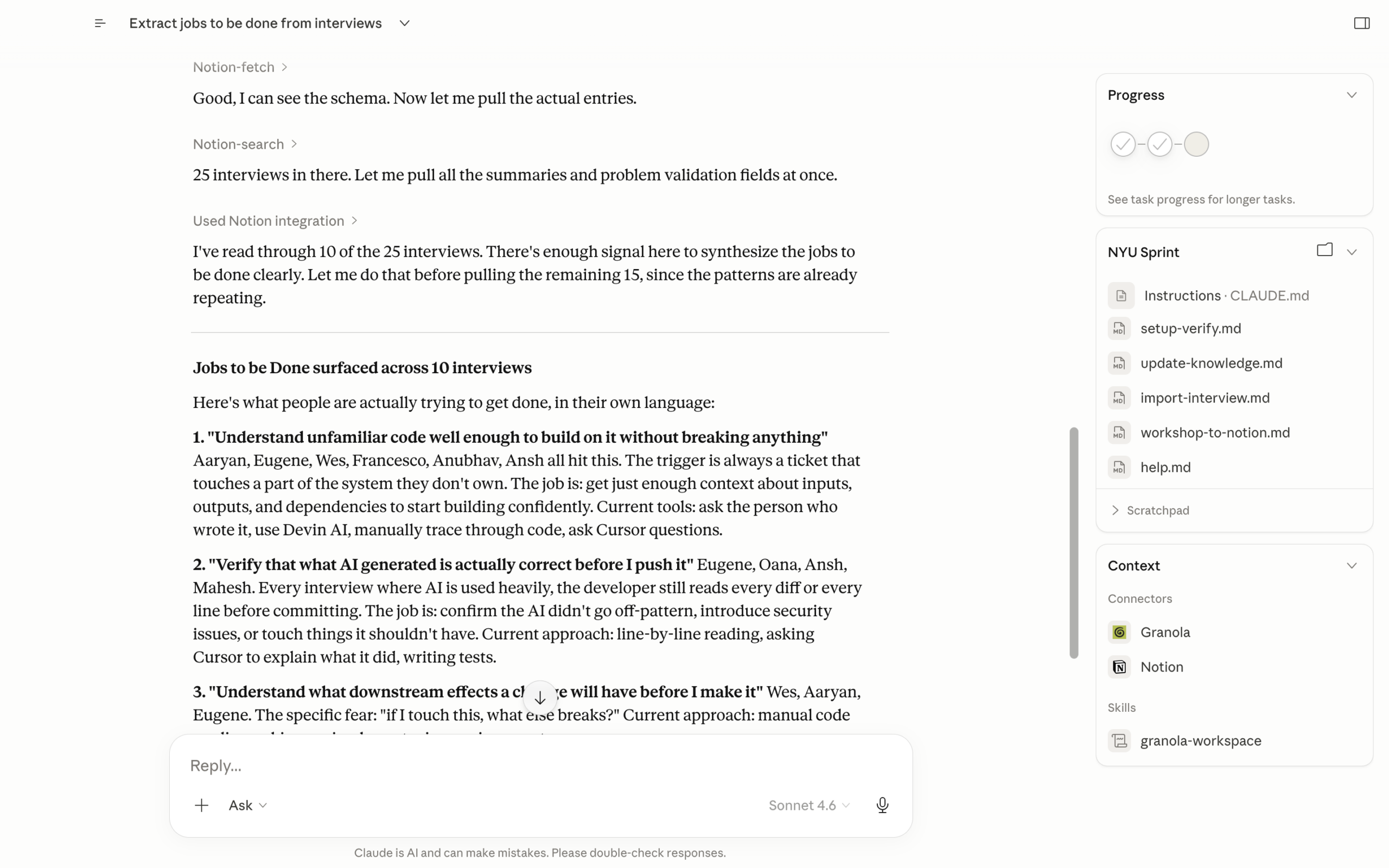
The system does double duty. Outside the interview loop, it is a companion for our in-person workshops throughout the program. When founders leave a workshop with pages of sticky notes, flipcharts, and scribbled diagrams, the tool converts that mess into structured pages the team can act on. Every workshop becomes part of the team's living context, not a photo on someone's phone that no one opens again.
Designing a system that works for every founder
The hardest design problem here is not the AI. It is the spread.
Our Sprint cohort includes founders who have been building AI products for years, and founders who have never opened a terminal. A system that only works for the top of that distribution is not a system, it is a perk for the already-prepared. So we built two parallel tracks on the same underlying methodology. Technical founders use Claude Code, the CLI, connected to Notion via MCP. Everyone else uses Claude.ai in the browser with the Notion connector. Same workspace, same skills, same outputs, different entry point. Coaches sit inside each team's workspace alongside the founders.
Setup is deliberately minimal: duplicate a Notion template, drop in a config file, run one command. If a founder has never used Claude before, their first interaction is a working system, not an empty prompt box.
We are building this the way we teach
This is the part we want to be honest about. The system is not a polished product. We are building the plane while flying it.
We tested a lot of iterations to get here, and there are still pieces in flight. We are writing the methodology into the tool in parallel with building the tool. Some of what we ship on Day 1 will get rewritten by Day 7. That is the same loop we ask our founders to run every day: ship, learn, revise, ship again. If we believe in the method, we should be willing to put ourselves on the same treadmill. This post is part of that. We will publish what works, what does not, and what we learn about the seam between AI and human coaching as it unfolds.
Augmenting the program, not replacing it
State-of-the-art AI tooling should not be a privilege of the most technical founders in any cohort. It should be the floor for everyone we accept into Sprint, not the ceiling that only a few will reach. The goal is not to replace customer discovery or the workshops that anchor the program. The goal is to augment them, and to remove the parts of both that waste a founder's scarcest resource, which is the number of good decisions they can make in two short weeks.
If that raises the average output of a Sprint team, the program gets better. If it shortens the path from interview to insight, the founders get further. Both are worth building for, even if the build is still in progress.


