





In my first post (Unlocking Impact: What NYU Researchers Need to Know About the NSF I-Corps Program), I explored how the NSF I-Corps program serves as a powerful catalyst for moving research from the lab to the world. In the second, I broke down what's new in the NSF I-Corps team program in 2026 (The New Roadmap for NSF I-Corps: What's Changed in Funding and Program Structure). Now, we are focusing on the final hurdle of the pre-submission phase: the Executive Summary, a two-page document that serves as your NSF I-Corps application.
To successfully meet the requirements of the latest NSF I-Corps Team solicitation (NSF 25-549) and its corresponding FAQ, you must submit an application, an Executive Summary, that speaks the NSF’s language: prioritizing scientific lineage and customer discovery hypotheses over a traditional investor pitch and addressing six required elements (Team Members, PI, Lineage, Technology, Application/Market, and Current Plan). This is where your team’s narrative takes shape, and getting the terminology, structure, and length right is essential for advancing to the national stage.
The Team: Roles, Bios, and Geography
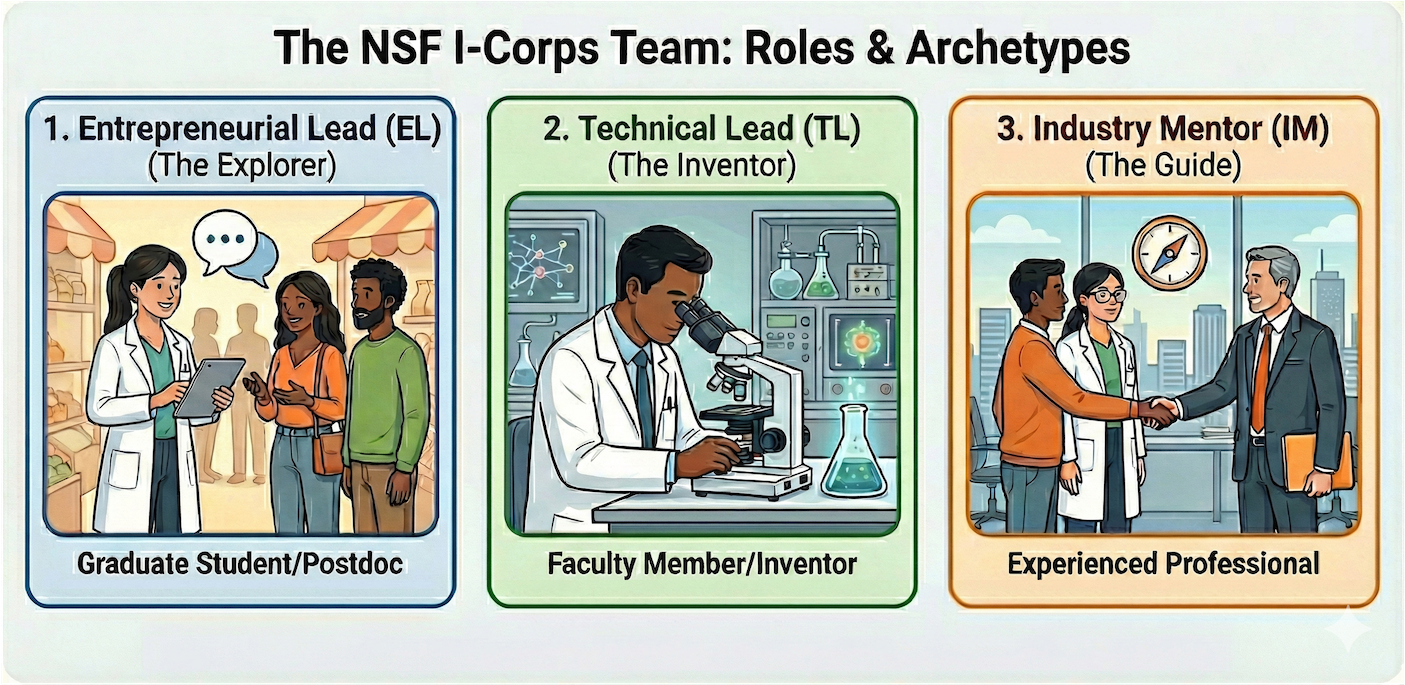
The NSF requires a specific team structure of at least three distinct roles:
- an Entrepreneurial Lead (EL), typically a graduate student or postdoc working on the technology with the TL or PI;
- a Technical Lead (TL), usually the inventor of the technology who is a faculty member and PI on the application; and
- an Industry Mentor (IM), a someone from outside of NYU with significant entrepreneurial and translational experience in the specific industry (and no financial interest in the technology/venture).
While three members are the minimum, NSF notes that teams with more than four members will typically not be supported, so treat four members (e.g., with a Co-EL) as an upper bound unless you can clearly justify additional roles that add distinct value. Write a 3–5 sentence bio for each, highlighting their day-to-day role at NYU (e.g., PhD candidate, postdoctoral fellow, professor, etc.), academic training/pedigree, history of collaboration, and confirming that they are physically located in the U.S.
- CRITICAL ELIGIBILITY NOTE: Every team member must be physically based at a U.S. university location for the duration of the program. If any member lists an international affiliation (like NYU Abu Dhabi or Shanghai) or is outside the U.S. during the seven-week program, the team is disqualified.
- A Note on Mentors: If you don't have an IM yet, leave that section blank. We can use your draft to help you find one.
The Three Core Sections of Your Executive Summary
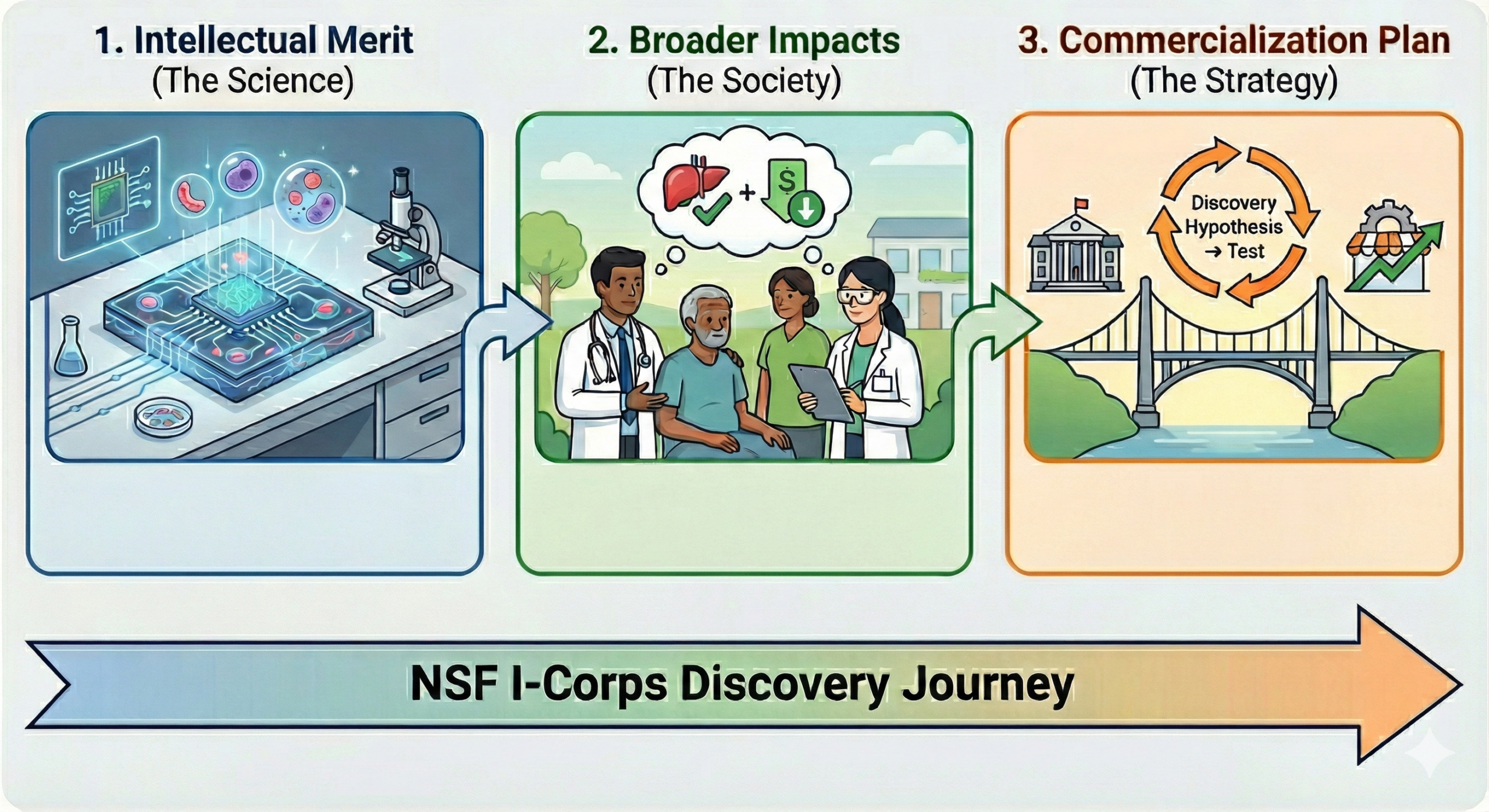
Once you’ve established your team, the NSF requires three specific narrative sections that mirror the agency’s broader review criteria. These aren’t just prompts; they are the exact structure NSF reviewers will use to evaluate your application. Here’s what each section must accomplish.
1. Intellectual Merit
Following the standards set in the official solicitation, this section must provide a brief, straightforward description of the core technology, its academic roots, what makes it unique, and its current stage of development, without disclosing proprietary details. Start by clearly stating which NYU lab developed the innovation. Your goal is to demonstrate that this is a "deep technology" breakthrough, a significant scientific leap, rather than an incremental update or a simple application of existing software tools. Confirm that the technology has been officially disclosed to the Technology Opportunities & Ventures (TOV, NYU's tech transfer office), including the status of the response or notification of their intent to protect the intellectual property. Mention your history of peer-reviewed publications and any filed patent applications to establish technical credibility.
- A Note on Software-based Projects: Software solutions must demonstrate a fundamental breakthrough in technology rather than just a development effort using existing tools. If the description sounds like standard app development, reviewers will likely deem it out of scope for I-Corps.
2. Broader Impacts
The Broader Impacts section is your best guess at the commercial potential and societal benefit of your work. The NSF looks for specificity regarding customer segments and value propositions. Instead of claiming a vague market like "Big Pharma" or "Healthcare," you should identify the specific human being who feels the pain you are solving; using titles like "Director of Toxicology" or "Head of Preclinical Safety". Describe the localized use case where your technology provides a solution, highlight how your research led you to believe a commercial opportunity exists, and focus on how this innovation could provide significant societal impact.
In addition, include your initial hypothesis about how much a customer might pay for your solution and a sentence on how you arrived at that estimate (for example, by comparing to current alternatives, internal cost estimates, or early expert feedback). This helps NSF see that you are already thinking concretely about value, willingness-to-pay, and the competitive landscape.
3. Commercialization Plan
Finally, outline your path forward. This is not a final business plan; it is a concise description of your starting hypotheses regarding technical and market risks and how you plan to test them during the program. You should describe the current stage of development (for example, lab concept, proof-of-concept, prototype, or similar) and briefly note any prior funding and what it has supported so far.
Explain how you plan to use the 100+ I-Corps interviews to validate your product–market fit and refine your understanding of the problem, customer, and value proposition. If you participated in the Tech Venture Workshop, briefly describe how the customer discovery work you conducted there has informed your initial hypotheses and what key questions remain to be answered through your participation in the National I-Corps program.
- THE RED FLAG: You should explicitly state that the team "intends to form a company" to commercialize the technology. However, if you have already formed a company, received any external investment, or are already revenue-generating, the NSF will likely view you as "too far along" for this discovery-focused grant. The team is generally ineligible if they have already received SBIR/STTR funding or significant private investment for this specific technology.
- A Note for Repeat TLs/PIs: Technical Leads who have participated in a previous NSF I-Corps award must be at least one year from the submission of their previous final report and must be working on a significantly different technology.
Mandatory Lineage Citation
To verify your eligibility for the (National) NSF I-Corps Teams program, you must include one of the following sentences at the conclusion of your summary:
- For Regional Hub Participants: "Our NSF lineage is established via our participation in the NYU Tech Venture Workshop (a regional I-Corps program) funded by the NSF's New York Region I-Corps Hub: NSF-IIP-2048498."
or - For Prior NSF Awardees: "Our NSF lineage is established via a prior NSF research award [Insert Award Number] within the last five years related to this technology."
Ready to Apply?
Before you hit "submit" on the NSF I-Corps Teams Application Portal, run through this final eligibility checklist. Meeting these specific criteria is what separates a draft from a funded proposal.
🖕🏻Pro Tip: Once you have a draft of your executive summary, upload it to Gemini and ask if it meets the requirements outlined in this blog post!
The Pre-Flight Checklist
- The Two-Year Window: If you are using the NYU Tech Venture Workshop as your lineage, ensure your team completed it within the past 24 months.
- The "Deep Tech" Standard: For software teams, does your summary clearly describe a fundamental technological breakthrough, or does it sound like a standard app development project? (The latter is a common reason for rejection).
- The PI Requirement: Ensure your Technical Lead (TL) is the Principal Investigator (PI) of record at NYU and that the university has been notified of the technology disclosure via TOV.
- The One-Year Rule: If your TL has done National I-Corps before, ensure it has been at least one year since they submitted their final report for the previous award.
- The Funding Boundary: Confirm your team hasn't already received SBIR/STTR funding or significant private venture capital for this specific technology. I-Corps is for discovery, not for scaling an already-funded company.
Get a Final Review
We strongly recommend reaching out to the Leslie Entrepreneurial Institute team before finalizing your document. We are happy to review your Executive Summary draft to ensure it meets these specific standards.
- Coaching: Sign up for a "NYU Research Commercialization" coaching session with a member of our team for personalized feedback.
- Mentor Matching: If you don't have an Industry Mentor (IM) yet, we can use your draft to help find a qualified professional with the required translational experience.
- Hub Verification: The revised process requires a Letter of Recommendation from the NY I-Corps Hub for teams without a prior NSF research grant. We can facilitate the mandatory interview and verification process needed for this letter.
For a deeper dive into these requirements, please consult the official NSF 25-549 Solicitation and the I-Corps Teams FAQ.


