


Entrepreneurs don't all enter entrepreneurship through the same door.
Some founders begin with technology. They know how to build, so they create an app, platform, or product and then look for people who need it. This is the familiar technical-founder path:
Build → find users → refine the product → scale
Technical founders can create and test products quickly. But they may also spend months building something before discovering that they cannot find customers. Startup ecosystems have developed strong methods to help these founders conduct customer discovery and find product-market fit.
Other founders begin with the customer.
They understand a problem because they have lived it, worked inside it, or already built a service around solving it. They may have paying customers, revenue, and strong evidence that people value what they do.
Their problem is not necessarily demand.
It is leverage.
A tutor grows by hiring more tutors. A consultant grows by adding consultants. A designer grows by producing more inventory. These can all become successful businesses, but growth remains closely tied to additional people, hours, or physical resources.
For these founders, the question is almost the reverse:
People need what I've built. How could technology allow me to deliver it at a completely different scale?
Entrepreneurship centers and accelerators have developed strong methods for helping technical founders find customers, but far fewer for helping domain experts find leverage because at first glance these companies appear to only be small businesses.
This should change. As technology becomes cheaper and more accessible, founders who already understand an industry or customer can more easily build scalable digital products around that expertise in ways that were previously difficult or impossible five years ago.
The Digital Leverage Audit offers a starting point for discovering those opportunities.
The Digital Leverage Audit
For founders who already have customers and a functioning business, there are six places to look for opportunities to scale through technology.
1: Automate the repetitive work
Start with the simplest layer.
Where does your team repeatedly spend time on scheduling, intake, customer communication, reporting, billing, research, inventory, or administration?
AI and software can increasingly handle parts of these processes, freeing founders to focus on selling, creating, and growing.
Automation may not change your business model, but it creates capacity.
Ask yourself: What work do we perform repeatedly that could be streamlined with technology?
2: Productize what you know
Most service businesses contain knowledge that lives inside the founder's head.
Perhaps you repeatedly diagnose the same problem, have developed a framework for making decisions, or follow a process that consistently produces better outcomes.
That expertise can sometimes become a template, assessment, digital course, recommendation engine, AI assistant, or other product customers can use without requiring the founder every time.
Ask yourself: What knowledge or expertise do our customers currently pay a person to access that could become a product in its own right?
3: Separate value from founder time
Break the customer experience into steps.
What happens before, during, and after someone works with you? Which parts truly require your judgment, presence, or relationship, and which could happen without you?
A coach might keep live sessions but move intake and assessments online. A consultant might automate part of the analysis. An educator might turn repeated explanations into self-guided learning.
The goal is not to remove the human element entirely from your business, but to identify where your time creates the most value and where technology can carry the rest.
Ask yourself: Which parts of the customer experience truly require us, and which parts could deliver value even without people in the loop?
4: Find the data you are already creating
Many businesses generate valuable data long before they think of themselves as data companies.
Every customer interaction can reveal something: what people prefer, which recommendations work, where projects fail, or what predicts a successful outcome.
Over time, this information can become an asset that improves decisions, personalizes services, reveals patterns, and potentially powers new products.
A recruiter might discover which candidate characteristics correlate with successful placements. A tutoring company might identify which interventions work best for different students. A marketplace might learn which buyer and seller characteristics lead to successful matches.
That accumulated knowledge can create several kinds of leverage:
- Better decisions: Improve recommendations, matching, pricing, or prioritization.
- Personalization: Tailor services using patterns from similar customers.
- Benchmarking: Help customers understand how they compare with peers.
- Prediction: Identify which opportunities or interventions are most likely to succeed.
- New products: Turn insights into dashboards, recommendation engines, or industry intelligence.
When a product improves as its proprietary data grows, that data can also become a competitive advantage.
Ask yourself: What are you learning from every customer or transaction that could make your product more valuable over time?
5: Look for the network
Sometimes the scalable layer is not software itself. It is the connections a business already creates.
A wedding planner connects couples with vendors. A career coach connects candidates with employers. A community organization connects members with experts and opportunities.
Whenever a business repeatedly sits between groups that need one another, there may be the beginnings of a marketplace or network business.
The founder's original service creates the relationships and trust. Technology may eventually allow participants to connect more directly, without requiring the founder to facilitate every interaction.
Ask yourself: Who do you repeatedly connect, and could those connections become part of a product that scales beyond your time?
6: Build the smallest tool you wish existed
Imagine a great software engineer joined your company tomorrow and asked:
What is one thing I could build that would make this business dramatically easier if given 48 hours of my time?
Maybe it is a better way to price projects, match clients with providers, manage applications, or generate recommendations.
You do not need to build a full app. Start with one repeated task or bottleneck and create the smallest tool possible that improves it.
That might be a spreadsheet with automation, a form connected to a database, a no-code workflow, or an AI assistant that follows your process.
A matching system, for example, might begin as a spreadsheet with a scoring method, become an internal database, and only later develop into a standalone product.
Start with the workflow. Prove the value. Then build further.
Finally, ask whether other businesses like yours face the same problem. If they do, the tool you built for yourself may become something others will pay to use.
Suddenly your service business becomes the testing ground for a scalable digital layer on top of your business.
The Digital Leverage Ladder
Digital leverage can happen gradually. A founder might move through:
Manual service → digitally enabled service → productized expertise → self-service product → proprietary data → network or marketplace → software platform
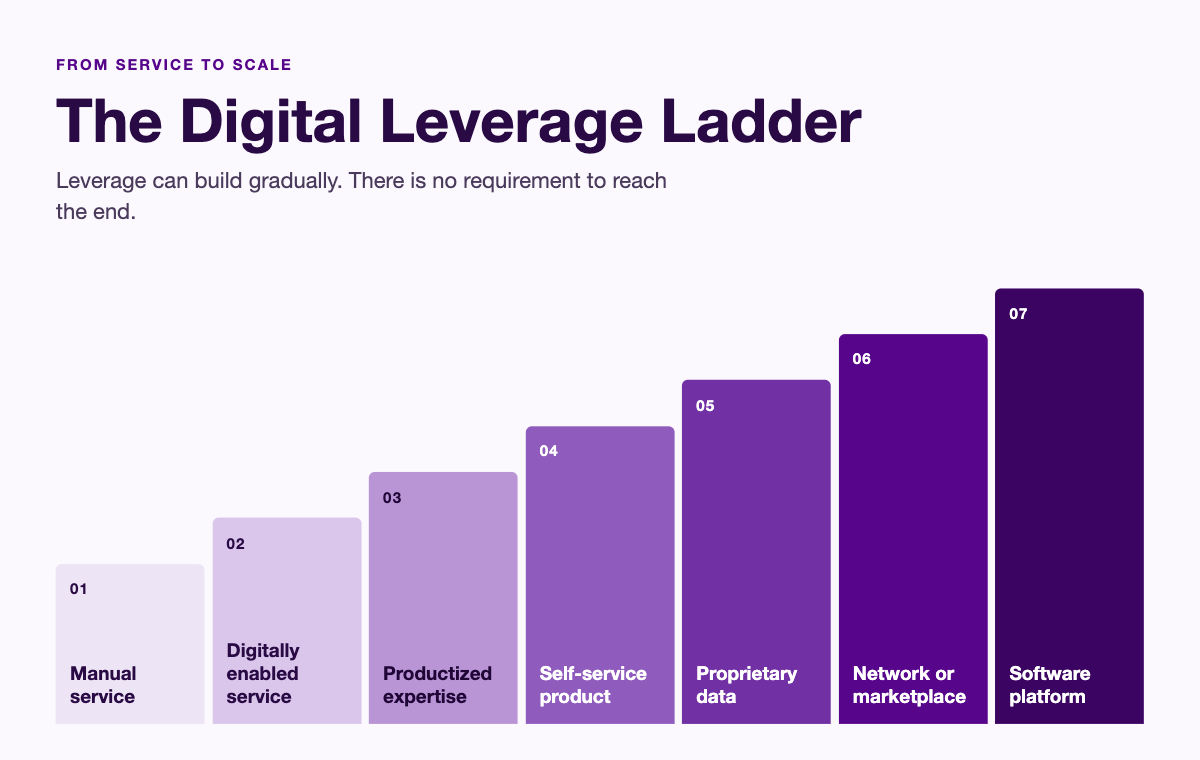
And there is no requirement to reach the end.
Technology might help turn a $500,000 service business into a highly profitable $2 million company without ever becoming a venture-backed SaaS startup.
That is still leverage.
The point is not that every physical or service-based company should become a software business. It is that in this new era where it is becoming easier to move from non-technical to technical, small business founders should understand the possibilities now available to them. There are now far more opportunities to build scalable companies without starting as technical founders---they just need the right mental frameworks and tools.
A Different Kind of Startup Support
As technology becomes easier to access, universities, accelerators, and entrepreneurship programs in turn have an opportunity to rethink how they support founders.
Entrepreneurship education has so often begun with someone who has built an untested product and needs to validate the market. But other founders are arriving with something increasing valuable in this new era: customer relationships, domain expertise, revenue, and firsthand knowledge of an industry.
Rather than asking these founders to start over or to wait for a technical co-founder, programs can help them identify the digital potential in what they have already built, connecting them with AI and no-code tools, as well as methods for translating their knowledge, data, and networks into scalable products.
At NYU's Leslie eLab, we want to help all founders, no matter the path they started on, to take their ideas further.
Because sometimes the scalable technology company does not come before the customers.
It is discovered because of them.


